
Allama Muhammad Iqbal is remembered as one of the greatest poets, thinkers and visionaries in the Muslim world. His poetry is not just appreciated by its beauty, but it is filled with the wisdom and strong ideas, which are concealed behind each verse. He is described as poet of the East ( Shair -e -Mashriq ) owing to the fact that his poems stirreds hope, courage, self-respect and spiritual strength.
The words of Iqbal touch the listeners of all ages. His poems have inspired students, scholars have found philosophy, leaders have found vision and every everyday reader has found emotional and spiritual guidance. His message is based on khudi, individuality, self-development and awakening of inner being.
In stark contrast with the work of common poets, there is a mission in Iqbal work: to inspire the soul, build character, wake-out nations, and bring people closer to Allah. This is in this expanded blog that we explore the life of Iqbal, his education, philosophy, poetry, books, and even its enduring legacy that has motivated millions of people all over the world.
🕯 Who Was Allama Iqbal?
Allama Muhammad Iqbal(1877-1938) was not only a poet, but a philosopher, scholar, lawyer, political thinker and a spiritual reformer. He was born in Sialkot and brought up in a family that emphasized on knowledge, religion, and culture. Later on in life, Iqbal discovered that literature and poetry could be used to influence minds and wake up nations.
Iqbal had written a lot of books in Urdu and Persian and he combined spirituality, philosophy, and motivation. He thought that the real success lies in inner strength, faith, character and self knowledge. He attempted to put back the spirit of Muslim people of the subcontinent through his poetry reminding them about their great history and their future prospects.
His poetry was to educate and transform and inspire, and not to amuse. That is why Iqbal is such a tall poet whose words have touched the hearts and the history.
🎓 Early Life & Education
Iqbal started his life in Sialkot where he had his early education. His genius and passion to learn were evident at a tender age. He read Arabic, Persian and Urdu books, and this formed the basis of his poetry genius.
College Education
Iqbal subsequently immigrated to Lahore and joined Government College University where he pursued philosophy, literature and political science. His teachers saw his talent especially Sir Thomas Arnold who had a significant influence on the intellectual journey of Iqbal.
Higher Studies in Europe
Iqbal went to Europe for further education, which became a turning point in his life. During this period, he completed:
- Bachelor of Arts
- Master’s in Philosophy
- PhD from Munich (his thesis was on Persian metaphysics)
- Law degree from England
Europe introduced him to the west and the civilized world and new systems of education. Nevertheless, Iqbal did not blindly follow the Western culture but took advantage of this experience to see the strengths and weaknesses of the two civilizations.
His life experience of Eastern spirituality and Western philosophy created the peculiar blend that made his poetry powerful, harmonized, and eternal.
🌟 Iqbal as a Poet: Themes & Style
The poetry of Iqbal is unequalled due to its richness, variety and the universality. He also approaches it in an emotional and intellectual way that is heart-inspiring and mind-challenging.
✦ Self-Awakening (Khudi)
Khudi is the central theme of Iqbal’s poetry.
It teaches:
- Discover your true identity
- Value your potential
- Strengthen your character
- Rise above limitations
- Never surrender to fear
Iqbal believed that when a person understands his own worth, he becomes unstoppable.
✦ Faith & Spirituality
Iqbal’s poetry has a deep connection with Allah, spirituality, and the inner soul.
His verses guide readers toward:
- Purity
- Trust in Allah
- Moral strength
- Spiritual awakening
His words bring peace, hope, and clarity during emotional struggles.
✦ Youth Motivation
Iqbal believed that youth are the architects of the future.
He encouraged them to:
- Think boldly
- Dream big
- Work hard
- Avoid laziness
- Build strong character
The “Shaheen” symbol represents the ideal youth—free, fearless, disciplined, and visionary.
✦ Muslim Identity
Iqbal was reminding Muslims about their great history and telling them to restore their strength with the help of unity, faith, and knowledge.
✦ Struggle & Hard Work
Iqbal taught that success only comes through effort.
His verses push readers to:
- Challenge difficulties
- Avoid excuses
- Break comfort zones
- Build courage
His poetry is like a mentor guiding every generation.
💬 Famous Allama Iqbal Poetry (Urdu + Roman Urdu)
🌙 1. Khudi Poetry
خودی کو کر بلند اتنا کہ ہر تقدیر سے پہلے
خدا بندے سے خود پوچھے، بتا تیری رضا کیا ہے
Khudi ko kar buland itna ke har taqdeer se pehle
Khuda bande se khud puchhe, bata teri raza kya hai
🌙 2. Youth Inspiration
ستاروں سے آگے جہاں اور بھی ہیں
ابھی عشق کے امتحاں اور بھی ہیں
Sitaron se agay jahan aur bhi hain
Abhi ishq ke imtihaan aur bhi hain
🌙 3. Motivational Verse
نہیں ہے نااُمید اقبال اپنی کشتِ ویراں سے
ذرا نم ہو تو یہ مٹی بہت زرخیز ہے ساقی
Nahi hai na-umeed Iqbal apni kisht-e-veeran se
Zara nam ho to ye mitti bohot zarkhaiz hai saqi
🌙 4. Faith & Spirituality
لب پہ آتی ہے دعا بن کے تمنا میری
زندگی شمع کی صورت ہو خدایا میری
Lab pe aati hai dua ban ke tamanna meri
Zindagi shama ki soorat ho Khudaya meri
📘 Iqbal’s Most Famous Books
Iqbal created masterpieces in both Urdu and Persian, and his books are studied worldwide.
✔ Bang-e-Dra (بانگِ درا)
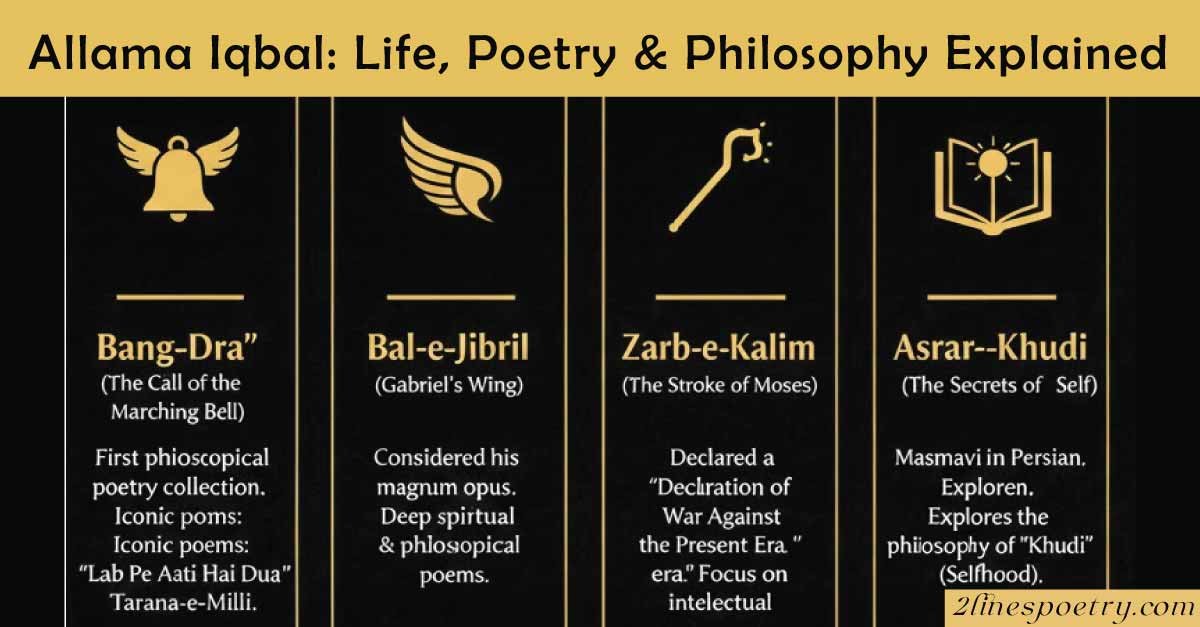
Bang-e-Dra is a wide range of total fusion of patriotic poetry, inspirational verses, moral tales, and emotional meditations. It contains the poetry of children, national songs, spiritual. This book also presents such great poems as Lab Pe Aati Hai Dua which makes it an everlasting masterpiece to be studied by the readers of every age.
✔ Bal-e-Jibril (بالِ جبریل)
Bal-e-Jibril is the highest point of Iqbal in his philosophical and spiritual manifestation. The poems discuss the self discovery, love and inner awakening. Full of metaphors and wisdom, it urges the readers to transcend the boundaries and re-touch their spiritual purpose and is thus one of the best loved books by Iqbal.
✔ Zarb-e-Kalim (ضربِ کلیم)
Zarb-e-Kalim is a bold call by Iqbal to the revival of Muslims, character, education, and leadership flaws. It questions materialistic thoughts and calls the young Muslims to restore their identity by being courageous, faithful and disciplined. The novel also heavily focuses on respecting oneself, solidarity and visionary leadership towards the new generations.
✔ Asrar-e-Khudi (اسرارِ خودی)
Asrar-e-Khudi is the revolutionary work of Iqbal who interprets the real meaning of Khudi or selfhood in Persian language. It is a lesson on how one can be self-aware, disciplined, and strong to become a strong personality. Iqbal leads the readers to the process of identifying their potential and reaching spiritual and moral heights through poetry and philosophy.
✔ Payam-e-Mashriq (پیامِ مشرق)
Payam-e-Mashriq is a reflective reply of Iqbal to the western thinkers and invites the Eastern spirituality to engage in dialogue with the Western progress. The book brings out the power of the Eastern values, moral purity, and spiritual wisdom that reminds the human race the value of balance between the intellect and faith in the creation of a better world.
Such books are still included in the academic courses, research articles, Islamic studies and literary discourses.
🦅 Concept of Khudi – Iqbal’s Central Message
The most significant philosophical idea of Iqbal is 8- Khudi. It is a lesson that all people are divine sparks, that there is some power in them, that they are individuals.
According to Iqbal:
- Khudi gives courage
- Khudi gives independence
- Khudi gives vision
- Khudi gives purpose
- Khudi gives leadership
Iqbal was of the view that nations emanated when people believed in themselves. Khudi has nothing to do with arrogance and ego, but rather the understanding of inner strength, with spiritual awakening, and disciplined self-development. When one learns, develops, and perfects his Khudi, he surpasses constraints and becomes an individual with a strength, superior and influential personality.
✨ Iqbal and Youth of the Nation
Iqbal considered the youth to be the real constructors of tomorrow because he believed a lot in their passion, energy, and creative potential. He mentors the youths through his numerous poems to dream big, work hard, be disciplined, character-build, and create a great and visionary future.
- Aim high
- Avoid laziness
- Learn constantly
- Stay honest
- Develop leadership qualities
He named the young man who ideally should be Shaheen, a bird which never rests, never ceases learning, never dares to face difficulties, always demands the best. The message of Iqbal to the young people remains current nowadays. His poetry is still providing guidance and inspiration to students, professionals, and leaders.
🕌 Iqbal’s Islamic Philosophy
Islam is still the source of poetry and philosophy of Iqbal. According to him, Islam is not just a religion but rather a whole life style which helps humanity to achieve justice, unity, moral might, spiritual cleanness, discipline and purposeful living in all dimensions of life.
- Unity
- Justice
- Equality
- Spiritual purity
- Love for humanity
- Moral strength
Iqbal urged Muslims to re-unite with the Quran. In his opinion, social, moral and political strength are the results of spiritual strength. His poems are always serving as a reminder to the Muslims to do what is expected of any good Muslim to do, to spread justice, and to live a respectable life.
🕊 Political Vision & Two-Nation Theory
Iqbal became the first big leader to raise the idea of separate homeland of Muslims. He wrote his historic Allahabad Address (1930) which clarifies that Muslims are a distinct nation with their own values, culture and beliefs. This vision was later the basis of the Two Nation Theory which resulted in the establishment of Pakistan in 1947.
Although Iqbal passed away in 1938, nine years before Pakistan came into being, he is honored as:
- Mufakkir-e-Pakistan (Thinker of Pakistan)
- Shair-e-Mashriq (Poet of the East)
- Hakeem-ul-Ummat (Sage of the Muslim Ummah)
His political thought shaped the direction of the freedom movement.
🔥 Impact of Allama Iqbal on Today’s Generation
The poems of Iqbal are everlasting since human feelings, life struggles, aspiration, and dreams never fade away. His poems go directly to the heart, with eternal wisdom and encouragement. The relevance of his message and meaning in his words have made them strong, appropriate, and highly motivating to every generation.
Iqbal’s work continues to:
- Motivate students
- Strengthen faith in Allah
- Build confidence
- Inspire hard work
- Teach self-respect
- Encourage leadership
His poetry is commonplace in school curriculums, colleges and universities, social networking sites and orations. To this day, his verses are recited to people to get motivated, wise, and hopeful. The legacy he left behind by Iqbal is eternal, as he preached about eternal things.
🌸 Conclusion
Allama Iqbal was not only a poet he was a guide, visionary, thinker and awakener of souls. His poems also teach us to overcome fear, find our potential, develop a good personality, and make our relationship with Allah stronger. The words of Iqbal do not just qualify as poetry; they are a map on how to live a good life. The verses of Iqbal are not only encouraging, but he provides the wisdom, spirituality, or personal development you need. He left a bright legacy behind, as he taught us one great thing: Each human is capable of getting up, changing and defining his or her fate.
👉 Discover the beauty and power of poetry in our in-depth guide, “What is Poetry? – Understanding the Art of Words.” Explore its meaning, forms, and emotional impact. Whether you’re a beginner or a literature lover, this post will inspire you to read, write, and truly appreciate poetry.