
Mirza Asadullah Khan Ghalib is not simply a poet who can be found in history books, he is a moving spirit in the Urdu and Persian literature. His poems still continue to resonate in discussions, in classes, in poetry meetings and even when people are alone. The poetry of Ghalib addresses the human nature in depth that the readers of various epochs see themselves in it. Ghalib is about to know about love, loss, faith, doubt, and silent struggles of life.
Early Life and Background
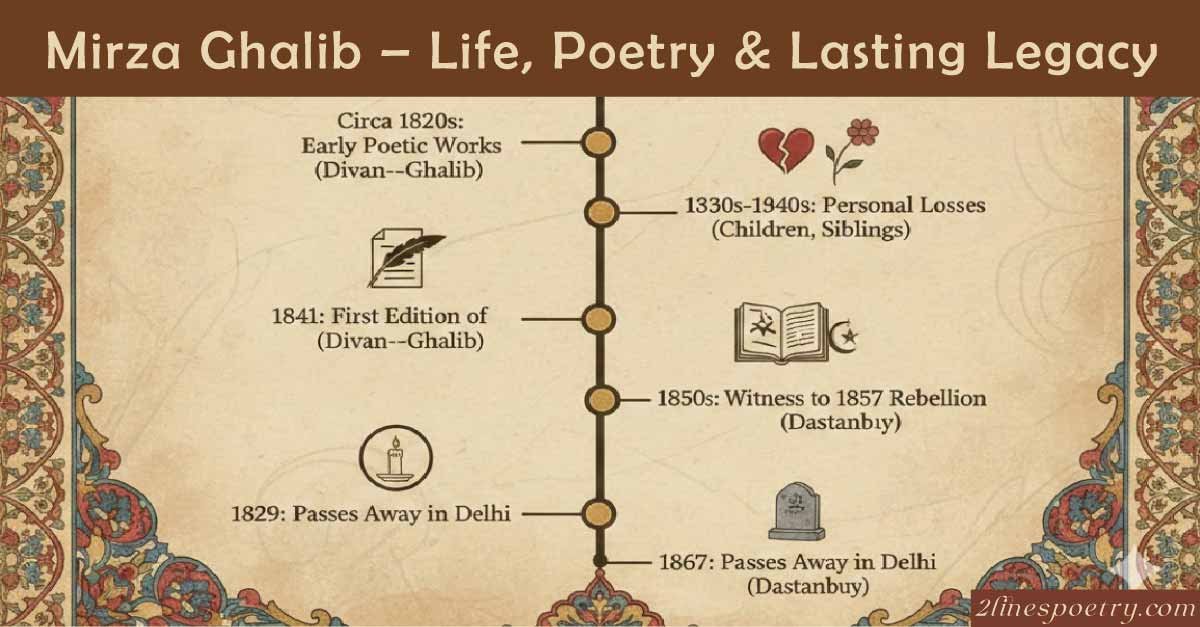
Mirza Ghalib was born on 27 December 1797 in Agra, on the waning times of Mughal Empire. He was born under the name Mirza Asadullah Baig Khan and later changed his pen name to Ghalib, which means dominating or victorious. Although known later in the life, the early life of Ghalib was full of suffering. His father died very early and he was then followed by the death of his uncle who acted as his guardian.
Ghalib had a great influence in his personality and poetry due to these early experiences of loss. The feeling of insecurity, flux, emotional instability which permeate his poetry can frequently be retraced back to his childhood. Ghalib was not afraid of the uncertainties of life as many other poets idealize life to be but turned the pain into philosophical thinking.
Education and Literary Influences
Ghalib was never schooled in the modern sense of the word but his intellectual sense was truly superb. He learned Persian, Arabic, philosophy and logic as well as classical literature through private tutors. His first literary love was Persian and he thought that the Persian poetry would be more recognized than the Urdu one. He was much influenced by the classical Persian writers like Hafez and Saadi whose styles of philosophy and mysticism made a lasting impression on his work.
Meanwhile, Ghalib transformed the Urdu poetry by leaving behind plain romantic concepts and introducing complicated thoughts, multidimensional meanings, and dialogical expression.
Marriage and Personal Struggles
Ghalib got married to the Umrao Begum when he was thirteen and shifted to Delhi which became the hub of his literary life. But marriage did not make it stable and happy. Ghalib experienced financial difficulties all through his life. His reliance on royal pensions, constant debts and his inability to find patronage brought him continual anxiety. What made his sadness worse was the fact that his children did not live long enough to grow up as he lost all his children when they were still infants.
This personal loss had a strong impact on his world vision. Instead of becoming bitter, Ghalib found poetry to be a place where he could challenge fate, divine justice and the meaning behind the suffering.
Ghalib and the Decline of the Mughal Era
Ghalib has lived during one of the most stormy periods in the Indian history. Mughal Empire was crumbling and as the British colonial authority was soaring. Delhi was devastated following the First War of Independence of 1857 otherwise known as the Revolt of 1857. Ghalib was the witness of the demolition of the cultural and intellectual world which he loved.
His letters, and writings of this time, furnish important and precious historical matter. Contrary to records, the stories narrated by Ghalib reflect the emotional and human aspect of political anarchy. He not only lamented the demise of an empire but also the life, traditions and values that had characterized Delhi over the centuries.
Ghalib’s Poetry: Beyond Romance
Despite the fact that Ghalib is remembered as the poet of love, his poetry is much more than the traditional romance. Love in the works of Ghalib is not about uniting or being separated, but it is symbol of yearning, craving and seeking the self. His lover is unattainable most of the time, which can be metaphorical to ideals, truth, even God.
Ghalib was able to express the abstract thoughts through simple language yet deep and this was one of the best gifts he gave to the world. His couplets can be interpreted in different ways, which leaves the readers to discover their own ways of reading. It is this frankness that makes Ghalib classic and internationally identifiable.
Philosophy and Thought
Ghalib was a poet not only but a thinker. His work indicates his strong introspection regarding issues of fate, free will, faith, and reason. He was frequently a doubter of the blind religiosity but he remained spiritually interested. Ghalib presents questions that make one think instead of answering them.
The poetry of his mind indicates a critical and yet optimistic, hurt and yet strong, mind. Ghalib embraced the human weakness and contradictions as it is an important aspect of life. It is one of the reasons why his poetry has become so contemporary even now.
Humor, Wit, and Letters
The other less well-known yet equally significant part of the legacy of Ghalib is his prose, and especially his letters. Ghalib transformed the letter writing style in Urdu by dropping the formal and strict style and establishing a conversational and personal conversation style. His letters appear to be a personal talk to the reader, full of humour, sarcasm and emotional sincerity.
With these letters we find Ghalib not as an abstract literary character, but as a man, grumbling about money, joking, expressing his frustration, and commenting on life as it comes. This autobiographical voice has hugely impacted the contemporary Urdu prose.
Recognition During and After His Lifetime
Ghalib did not find his time in the world to become popular and financially successful. Although he had command over literary circles, they did not recognize his genius on a general level. A large part of his success occurred after he died in 1869. In the course of time, readers, scholars and poets came to understand the scope and originality of his work. Ghalib is today regarded as one of the best poets of the Urdu literature taught in schools and honored in festivals of South Asia and other parts of the world.
Ghalib’s Influence on Modern Literature
The impact of Ghalib is much further than his own times. Contemporary writers and poets keep being inspired by his style, themes and his philosophical approach. The fact that he was able to integrate classical tradition with his personal expression is what opened the path to future generations of poets. The verses of Ghalib are commonly read in the films, TV dramas, and music. His poetry has been transformed into music and staging, exposing people who otherwise might not have read a classic ghazal to his work.
Why Ghalib Still Matters Today
Ghalib is still relevant in the fast-changing world, since he appeals to eternal human experiences. His poetry is not solace; it rather accepts confusion, doubt, and emotional conflict. This way, it offers companionship to the readers who go through their own uncertainties.
Ghalib shows us that it is not weakness to seek answers, that even the saddest things can exist together with beauty, and that words can express even the most inexpressible feelings. His work helps to make the readers think deeper, feel more straight and accept contradictions of life.
Conclusion: The Enduring Legacy of Mirza Ghalib
Mirza Ghalib was not merely a poet of words, but one of thought, feeling and experience. He was suffering in his life but his writing is the work of intellectual richness and emotional depth. Ghalib turned a subjective suffering into a general fact and poetry and prose brought this transformation.
Over 100 years after his death, Ghalib remains alive through his poems as he makes us understand that the best literature does not grow old; it only changes along with its audience. His heritage does not exist in books or reading it is in the minds of people who can find meaning, solace, and reflection in what he says.
Mirza Ghalib remains, undeniably, a voice that time has not silenced.
☝️ Faiz Ahmed Faiz – Life, Poetry, Ideology & Influence delves into the remarkable journey of Faiz Ahmed Faiz, exploring his revolutionary poetry, strong ideology, and lasting influence on literature and society. Discover his thoughts, emotions, and writings that continue to inspire generations. Read the full post to experience the brilliance and legacy of Faiz Ahmed Faiz in depth.