
Poetry is an art and has been a potent tool of expression throughout history, and it has enabled man to express his emotions, ideas, and narratives in a manner that is most likely to appeal to others. There are numerous types of poetry styles, and the 2-line poetry is one of them. These poems which are popularly known as couplets are short and simple yet very powerful and are a favorite among both writers and readers. However, even in a 2-line poem, it is possible to express strong emotions, give a philosophical commentary, or even make a sarcastic remark. We will be discussing the 2-line poetry, giving example and tips to write your own so that beginners and experienced poets have an easier time of writing an eloquent verse.
What Is 2-Line Poetry?
2-line poetry means poems which are composed of two lines. The lines are complementary to each other, and they give out a complete thought, emotion or idea. These brief verses are usually short but with the determination of strong emotions in few words only.
Two-line poetry is also referred to as couplet or more specifically when it is rhymed. Nonetheless, contemporary 2-line poems can also be written in free verse, where emphasis is put on the meaning and the effect more than the rhyme. The simplicity of a 2-line poem is its beauty, it requires accuracy, imagination and the possibility to say a lot within a small area of space.
Key Features of 2-Line Poetry:
Brevity: It is concise, consisting of only two lines.
Completeness: Each poem delivers a full idea, story, or emotion.
Impact: Despite its small size, it leaves a lasting impression on the reader.
Flexibility: It can rhyme or be free verse, humorous, romantic, motivational, or sad.
Importance of 2-Line Poetry
Why do poets and readers love 2-line poetry? Here are a few reasons:
Easy to Remember: Because they are short, 2-line poems are easy to memorize and share.
Powerful Expression: A well-written 2-line poem can convey intense emotions effectively.
Versatile: These poems can cover a wide range of emotions, including love, sadness, hope, motivation, and humor.
Ideal for Social Media: With the rise of social media platforms, 2-line poetry is perfect for sharing as quotes, statuses, or captions.
Examples of 2-Line Poetry
To better understand the form, here are some examples of 2-line poetry:
1. Romantic 2-Line Poems
- “Your smile lights up the darkest night,
In your eyes, the world feels right.” - “Even in silence, your voice I hear,
Your love remains ever so near.”
2. Motivational 2-Line Poems
- “Rise each day with courage in your heart,
Every new beginning is a work of art.” - “Failures are lessons, not the end,
With every setback, let strength ascend.”
3. Sad 2-Line Poems
- “Tears fall silently in the night,
Hoping one day, everything will be right.” - “Memories linger where we once stood,
A heart left longing for what it should.”
4. Funny 2-Line Poems
- “I tried to cook, but the kitchen cried,
Even the smoke alarm waved and sighed.” - “My dog stole my socks today,
I guess he wants them more than I may.”
These are examples of the versatile 2-line poetry and only two lines will help a poet to convey love, inspiration, sorrow or joy and will establish a profound bond with the reader.
How to Write 2-Line Poetry
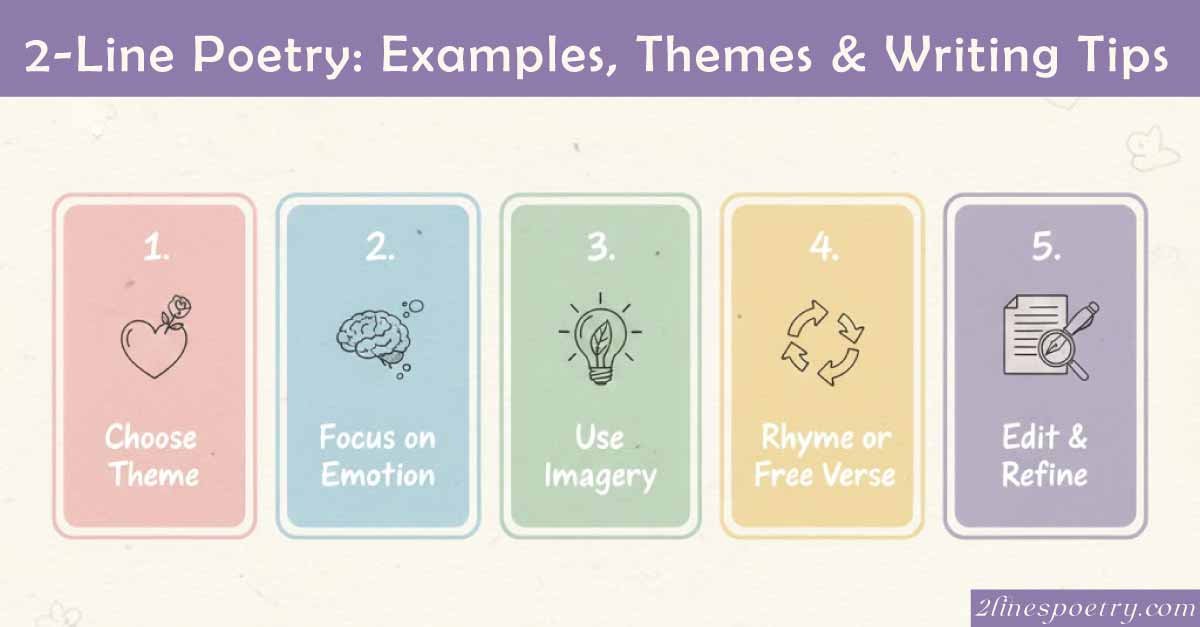
Poetry writing 2- lines poetry can be very easy due to the brevity of the text, but one has to be creative and select words carefully. There is no word to lose; therefore, you should pay attention to clarity, rhythm, and emotional appeal. Here’s a step-by-step guide:
1. Choose Your Theme
Before you start writing, you have to make some time and decide on the clear theme of your 2-line poem. Love, friendship, motivation, sadness, humor, and nature, or any other theme; the presence of a particular theme can provide your poem with a direction and make it present coherent meaning to the readers.
2. Focus on Emotion or Message
A 2-line poem is very short, and therefore the feeling or message should be clear, concise and effective. Think of your emotion, thought or thought that you would like to convey in two lines and be sure that every word reinforces your main message.
3. Use Vivid Imagery
Vivid imagery helps to make your 2-line poem to be memorable and interesting. Resonate mental pictures can be created with metaphors, similes or descriptions. Imagery is used to make the readers experience, visualize or visualize my feelings. For example:
“The moon whispers secrets to the night,
Stars twinkle softly, holding them tight.”
4. Decide on Rhyme or Free Verse
Consider whether your 2-line poem will rhyme or follow free verse. Rhymes have a memory melodic quality and free verse provides freedom of feeling and sense. These two styles are both acceptable, and the style you want to use should be dependent on the tone and the feeling of your poem.
5. Edit and Refine
2-line poetry requires editing. Read your poem aloud several times eliminating unnecessary words and enhancing rhythm. Make sure that each word is meaningful or emotive. A fine, elegant 2-line poem must be impressive, full, and have an impression on the readers.
Tips for Writing Engaging 2-Line Poetry
Be Concise: Use only words that add value to the poem.
Use Strong Emotions: Strong feelings resonate more with readers.
Be Creative: Experiment with metaphors, symbols, and unexpected comparisons.
Practice Regularly: Writing 2-line poetry becomes easier with practice.
Read Examples: Reading other 2-line poems can inspire new ideas and styles.
Common Themes in 2-Line Poetry
The 2 line poetry is so diverse and it can touch virtually any emotion, thought or circumstance. Even though they are short, these poems can be used to express love, inspire, make people laugh or cry. Learning familiar themes will assist you in making poems that are easily relatable by the readers.
1. Love and Romance
The subject of love is, perhaps, the most fashionable in 2-line poetry. Poets can use only two lines to show affection, longing, or admiration and establish a personal contact with the reader. Short love poems are effective since they express emotions in a rather short way, and the feelings become relatable and memorable.
Example:
“Your touch lingers even when you’re gone,
In my heart, your love will carry on.”
2. Motivation and Inspiration
2-line poems are good in the inspirational and motivational messages. Such little poems may make people remain optimistic, strive, or defeat difficulties. Their conciseness is ideal in the use as quotes or reminders that motivate to act and positively charge spirits within a few moments.
Example:
“Every step you take, brings dreams to light,
Keep walking forward, even in the night.”
3. Sadness and Heartbreak
2-line poetry is the kind of poem that poets use to lament, are heart broken or experiencing emotional conflict. Though quite brief, these poems express the uncivilized feelings in a very strong way, offering the readers an opportunity to sympathize with the feelings of the poet and think of their experiences of loss, pain, or longing.
Example:
“Shattered pieces of my silent heart,
Longing for a life that fell apart.”
4. Humor and Wit
2-line poetry humor is brief, witty, and usually mischievous. Through these poems, the readers can smile or laugh at witty things, puns, or situations in their daily lives. The humor makes it lighter and the short structure makes sure that the punchline strikes fast and right.
Example:
“I planned a diet, but cake had its say,
Now my workout’s tomorrow… or maybe today.”
Using 2-Line Poetry Effectively
2-line poetry is not just for personal expression. It can also be used effectively in various contexts:
Social Media: Perfect for Instagram captions, Twitter posts, or Facebook updates.
Greeting Cards: Short and emotional lines work well for birthday, love, or sympathy cards.
Journals and Diaries: Quick entries to capture thoughts and feelings.
Classroom or Writing Exercises: Helps beginners practice precision and creativity in poetry.
2-Line Poetry in Urdu
2-line poetry in Urdu has a particular cultural and literary value to those who love Urdu poetry. Most of the well known Urdu poets such as Mirza Ghalib and Allama Iqbal are famous poets who have made short but effective couplets called Sher which adhere to the same concept of 2-line poetry: brevity, completeness and emotion.
Example in Urdu:
“دل ہی تو ہے نہ سنگ و خشت، درد سے بھر نہ آئے کیوں”
“روئیں گے ہم ہزار بار، کوئی ہمیں ستائے کیوں”
Translation:
“It’s just a heart, not stone or brick, why shouldn’t it fill with pain?”
“We will cry a thousand times, why should anyone torment us?”
Common Mistakes to Avoid in 2-Line Poetry
1. Overcomplicating the Poem
2-line poetry is so beautiful because it is simple. Excessive use of words or having inappropriately complicated phrases can blur the effectiveness. Be direct and accurate and make each word count towards the feeling or impression you are trying to create.
2. Being Vague
2-lines poems must convey a definite emotion, narrative or concept. Imprecision may bewilder the reader and reduce the effect of the poem. Ensure that your lines are specific and intentional and they do not leave any ambiguity on what feeling or idea you are trying to convey.
3. Ignoring Rhythm and Flow
Although your 2-line poem is not supposed to rhyme, it must read well. Clumsy wording or sudden transitions may have a distracting effect on the reader. Keep time to the words and maintain the feel of natural flow of words, which adds emotional or lyrical feel to the poem.
4. Forgetting the Impact
A excellent 2-line poem leaves an indelible impression or causes a thinking process. Do not write lines that are either partial or shallow. Every poem must appeal to the reader, be it in emotion, mind or aestheticism, so that each word counts to the totality of the poem.
Final Thoughts
The 2-line poetry is a form of literature which is beautiful and multifaceted. It enables authors to portray emotions, thoughts and narratives in a very compressed manner. Even being very short, a well-made 2-line poem may be strong, impressive, and touching.
2-line poetry has no limits, as it can be enjoyed as a beginner in the world of poetry or as a more advanced poet who is willing to experiment. There is no one who cannot master the art of 2-line poetry by studying the structure, examples and practicing on a regular basis.
Remember to choose a theme, focus on emotions, use vivid imagery, and refine your work carefully. With these tips, you can create poetry that resonates deeply with readers, whether it’s shared online, in a personal journal, or even in Urdu literature.
☝️ 2-Line Poetry brings you the best Attitude Urdu Poetry, Bewafa Urdu Poetry, Sad Urdu Poetry, and Love Urdu Poetry in short, impactful lines. Explore emotional, romantic, and thought-provoking verses that touch the heart. Read the full collection to find your favorite Urdu Shayari, express your feelings, and share meaningful moments with friends and loved ones.