
Urdu poetry is not a simple piece of words joined together, but it is an art form, which shares the greatest emotions, cultural practices and eternal beauty of the Urdu language. Urdu poetry is loved not only in Pakistan and India but all over the world due to its unique appeal that can be characterized as rhythm or melody and deep meaning. Urdu poetry has the ability to convey love, sorrow, hope and social commentary few other languages can convey as clearly as it is conveyed in the verses of classical poets such as Mir Taqi Mir and Mirza Ghalib, all the way into the present.
Urdu poetry is no exception since it is a combination of emotion and artistry. In contrast to normal prose, it flourishes on metaphors, similes, and rhythmic rhymes to establish a musical and emotional effect. It may be a love ghazal, a touching nazm, a comedy sher, but the Urdu poetry expresses emotions in such a manner that appeals to both the listeners and readers.
In this blog, we will explore the history, forms, themes, and cultural significance of Urdu poetry, and how it continues to influence literature, music, and society today.
A Brief History of Urdu Poetry
Urdu literature has a history that is many centuries old. Urdu is a language that was developed in the Indian subcontinent and it is a product of Persian, Arabic, Turkish and indigenous Indian dialects. As a result, the Urdu poetry is strongly affected by the Persian poetic forms, especially the ghazal genre.
The Urdu poets who wrote in the early years contributed greatly to the development of the language and the Urdu literature. Mir Taqi Mir, the so-called God of the Urdu poetry, is a sensitive writer on the topics of love, heartbreak, and human condition. Mirza Ghalib, who would come later, would have a philosophical basis and write on the issues of existence, love, and social problems in elegant and wise terms.
The Urdu poetry has been able to keep up with the changing times absorbing the influences of politics, social movements and modern ways of living, but still retaining the original emotional and aesthetic value over the centuries.
Forms of Urdu Poetry
Urdu poetry has been admired due to its rich form. All of them are different in rules, style and structure, and poets can convey their inner feelings, love, grief and life events. Starting with ghazals and passing on to nazms, these literary works are a demonstration of the beauty and richness of the Urdu literature that can enchant readers of all age groups.
| Form | Description | Example Poets |
|---|---|---|
| Ghazal | A lyrical poem composed of rhyming couplets with a refrain, often about love and loss. | Mirza Ghalib, Faiz Ahmed Faiz |
| Nazm | A structured poem with thematic unity, not limited to rhyme, covering love, politics, or society. | Allama Iqbal, Ahmad Faraz |
| Marsiya | An elegiac poem written to mourn and honor the dead, often linked to the tragedy of Karbala. | Mir Anis, Dabeer |
| Qawwali | Devotional poetry set to music, often performed in Sufi gatherings. | Amir Khusro, Nusrat Fateh Ali Khan |
| Rubai | A quatrain with a specific rhyme scheme, usually expressing philosophical or moral thoughts. | Mirza Ghalib, Iqbal |
| Hamd & Naat | Poetry praising Allah (Hamd) or Prophet Muhammad (Naat), reflecting devotion and spirituality. | Allama Iqbal, Hafeez Jalandhari |
Themes in Urdu Poetry: Exploring Emotions
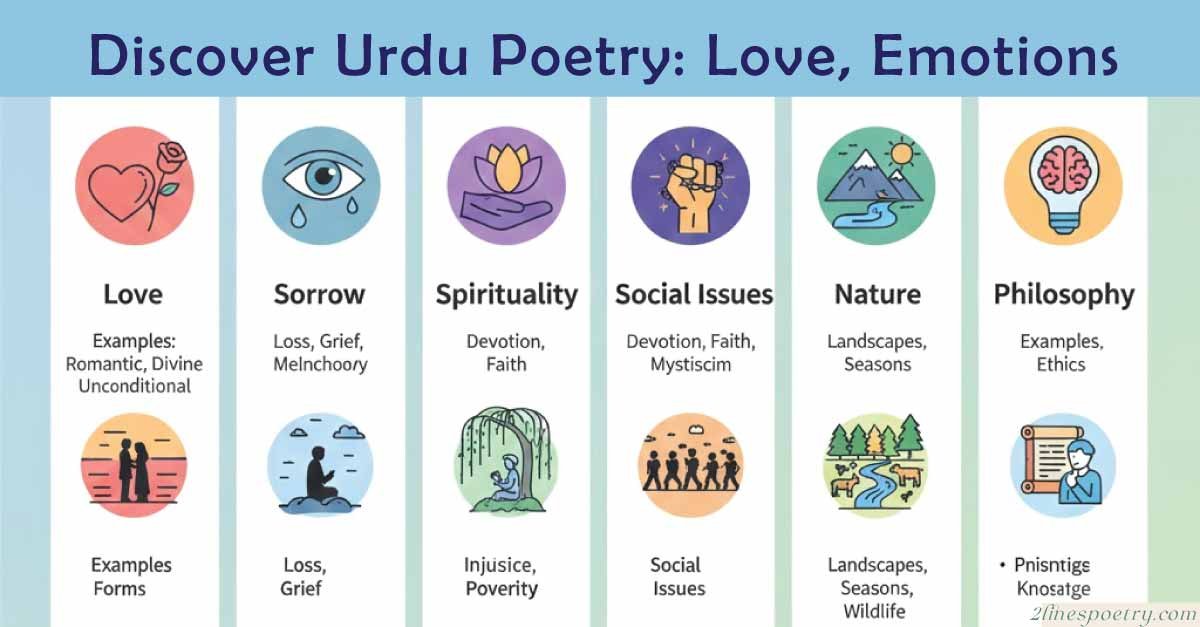
Urdu poetry has explored various themes that are representative of human feelings, experiences and the society which is considered one of the most interesting aspects of Urdu poetry. Themes are in deep content and the poets can reach the readers at various levels. These themes make Urdu poetry have a perennial appeal and worldly appeal.
1- Love and Romance in Urdu Poetry:
Urdu poetry is predominantly based on love and romance and the poets also are able to describe longing, passion, and heartbreaks in the most beautiful way. Since love that is not requited, till love that is eternal, these verses reflect the extremes of human feelings. Ghazals and nazms portray love as something happy and sad, to which the readers of all generations can easily relate.
2- Sorrow and Loss in Urdu Poetry:
The theme of sorrow and loss is a common theme in Urdu poetry, which is a personal experience of grief, heartbreak, and social tragedy. Expressive language by poets is used to express emotional pain, empathy and strength. The poems enable the readers to get catharsis, such that they can feel that they are not alone, and that human suffering is universal.
3- Spirituality and Devotion in Urdu Poetry:
Urdu poetry contains major themes of spirituality and devotion that discuss the relationship of a human being with God, faith and inner peace. Poets are grateful, give up, and have spiritual desires, which gives the readers hope and encouragement. These lines can be very comforting and thought-provoking, as they focus on the great importance of religion in forming life and worldview.
4- Social Issues in Urdu Poetry:
Urdu poetry tends to be very much social in its approach, providing a cynical viewpoint of injustice, inequality and political conflicts. Through their art, poets create awareness, change and promote the downtrodden in society. These poems have an appeal to the readers since they reflect the realities in the society and the poems are filled with emotion and intellectual appeal.
5- Nature and Beauty in Urdu Poetry:
The Urdu poetry glorifies nature and beauty, as poets portray the beauty, calmness and unity of the surrounding world. Landscape, season, and natural wonder descriptions are wonder and contemplation-inducing. These poems help the readers to remember the simplicity of pleasures in life and the inspirational nature of the natural world.
6- Philosophy and Existentialism in Urdu Poetry:
Urdu poetry deals with philosophy and existentialism by considering the questions of life, death, and the meaning of human existence. Poets reflect on the secrets of life, destiny, and awareness, giving the reader an opportunity to reflect on his/her life. These poetry verses are thought provoking and they not only are beautiful in literature, but also in the intellectual sense that they leave a lasting impression on the mind and heart.
7- The Versatility of Themes in Urdu Poetry:
Urdu poetry can appeal to readers of any age, background or culture due to the versatility of themes in the poems. Urdu poetry will be eternal and applicable as it is concerned with the universal feelings and experiences. The fact that the themes vary in an unprecedented variety makes sure that any reader can find verses to be inspirational, soothing and relevant to their current life story.
Why Urdu Poetry is Unique
Several factors make Urdu poetry stand out:
Musicality: The natural rhythm and meter make it a delight to recite and listen to.
Metaphorical Depth: Poets often use symbolic language to express emotions, making each line layered with meaning.
Cultural Heritage: Urdu poetry reflects centuries of cultural exchange, history, and social evolution.
Emotional Impact: Unlike simple writing, Urdu poetry has the power to stir deep feelings in the reader or listener.
Famous Urdu Poets and Their Contributions
Urdu poetry has continued to survive on the shoulders of its poets, whose voices, styles and outlooks are unique. Their works are emotional, social and cultural, and they have maintained the art form, as well as generations are being inspired and the rich tradition of Urdu literature is being kept alive through them.
| Poet | Era | Specialty |
|---|---|---|
| Mir Taqi Mir | 1723–1810 | Classical ghazals, romantic and emotional poetry |
| Mirza Ghalib | 1797–1869 | Philosophical ghazals, exploring life and love |
| Allama Iqbal | 1877–1938 | Nazms with nationalistic and spiritual themes |
| Faiz Ahmed Faiz | 1911–1984 | Revolutionary poetry and romantic ghazals |
| Ahmed Faraz | 1931–2008 | Romantic and socially conscious poetry |
| Parveen Shakir | 1952–1994 | Feminist perspectives and romantic expression |
Each of these poets has shaped Urdu poetry in distinct ways, and their works continue to inspire new generations.
Modern Urdu Poetry
The new Urdu poetry has developed to reflect the modern life yet maintaining the traditional grace. Nowadays poets are trying out new forms of verse, spoken word, digital mediums like social media and touching on social change, personal identity, mental health, love and global issues which is more relatable and accessible than ever.
Urban life struggles
Mental health awareness
Feminism and gender equality
Political and social critique
The availability of contemporary Urdu poetry has allowed it to live up-to-date and reach out to the youth as well as the world at large.
Cultural Impact of Urdu Poetry
Urdu poetry is not only a literature, it is a part of the South Asian culture. It has a touch on music, theater, television, and films. The singing of Ghazals has been performed by the great singers and poetic verses are recited during the meetings, weddings and cultural festivals. Moreover, Urdu poetry would facilitate language study, literature value and expression of feelings. It creates a bridge between generations and provides the view of the cultural environment of the subcontinent past and the present.
How to Appreciate Urdu Poetry:
To understand the Urdu poetry is not merely to read the words of the poems, it is to relate to the emotions, culture and the beauty of art in every line of the poem. The knowledge of the themes, expressions, and linguistic undertones enables the readers to experience poetry in its completeness.
1- Understand the Language:
Good understanding of Urdu is very beneficial to the appreciation of Urdu poetry. Familiarity with the language can also aid the reader in comprehending word puns, metaphors, and even cultural allusions that would otherwise have gone unnoticed. The wisdom will enable the poetry to sound deeper and more melodies and rhythms.
2- Listen to Recitations:
Poetry recitation makes ghazals and nazms alive with a focus on rhythm, intonation, and emotion. Delivery of the music also creates more meaning and the words become more powerful. The act of reading out poetry gives the person listening a more powerful sense of the feelings that the poet is trying to convey.
3- Explore Translations:
To a non-native speaker, it is informative to read translations and get to understand the meaning and the spirit of the Urdu poetry. Although it can be assumed that certain language subtleties are lost, translations ensure that the themes, emotions, and messages are related to the readers. They act as a medium of appreciation of poetry across language barriers.
4- Learn About the Poet:
The knowledge of life and experiences of the poet and his historical background deepens the Urdu poetry. The more the readers know about the personal struggles and beliefs of the poet and the inspirations, the more meaningful would be the interpretation of the verses by the readers and the more emotional attachment to the poetry.
5- Reflect Emotionally:
To value Urdu poetry is through reflecting emotionally. Allowing the verses to echo the personal experiences and memories and feelings adds more weight to the poetry. This is an emotion that enables the readers to immerse themselves completely and have a lasting relationship with the art.
Common Urdu Poetry Forms and Their Features
| Poetry Form | Meter/Rhythm | Theme Focus | Performance Style |
|---|---|---|---|
| Ghazal | Fixed rhyme, couplets | Love, loss, philosophy | Recitation, singing |
| Nazm | Flexible, thematic unity | Social issues, romance | Recitation, written |
| Marsiya | Elaborate, mournful | Mourning, tragedy | Recitation in elegy events |
| Rubai | Quatrain, AABA rhyme | Philosophy, reflection | Written or recited |
| Naat/Hamd | Free or rhymed | Devotion, praise | Recitation in religious gatherings |
| Qawwali | Rhythmic and musical | Devotion, Sufi themes | Musical performance |
Conclusion
Urdu literature is an eternal gem of literature that incorporates beauty, emotion and culture in each of the verses. Its expressions (ghazals, nazms, qawwali to rubai) offer limitless ideas to express, think, and be entertained. Urdu poetry has a rich experience that cuts across generations whether you are an ordinary reader, a literature student or an ardent fan. The magic of Urdu poetry can be enjoyed by anybody by knowing its history, by studying its themes and enjoying its forms. It captures human feelings and cultural heritage and this fact will keep it relevant and treasured in centuries to come.
📌 2-Line Poetry is a powerful way to express deep emotions in just two lines. From love and sadness to inspiration, these short verses capture hearts instantly. Learn the definition, examples, and tips on how to write 2-line poetry effectively. Dive into our full post to master this beautiful art form and create impactful, memorable poetry.