
Faiz Ahmed Faiz is not just a poet whose verses are memorized and quoted, he is a voice that continues to breathe inside the collective conscience of Urdu literature. His poetry does not languish on bookshelves. It marches in demonstrations, speaks in love letters and resounds in times of discrimination. Reading Faiz means experiencing beauty and revolt in one stroke, gentleness and defiance at the same time. Faiz is highly present unlike other poets who are deeply rooted in the past. His words continue to resonate into fractured hearts, suppressed voices and hopeful minds.
He wrote of love, of course but also of chains, of exile, silence, of the dream of a better world. Just like his poetry, his life was also defined by struggle, thinking and uncompromising faith in mankind.
Early Life and Education
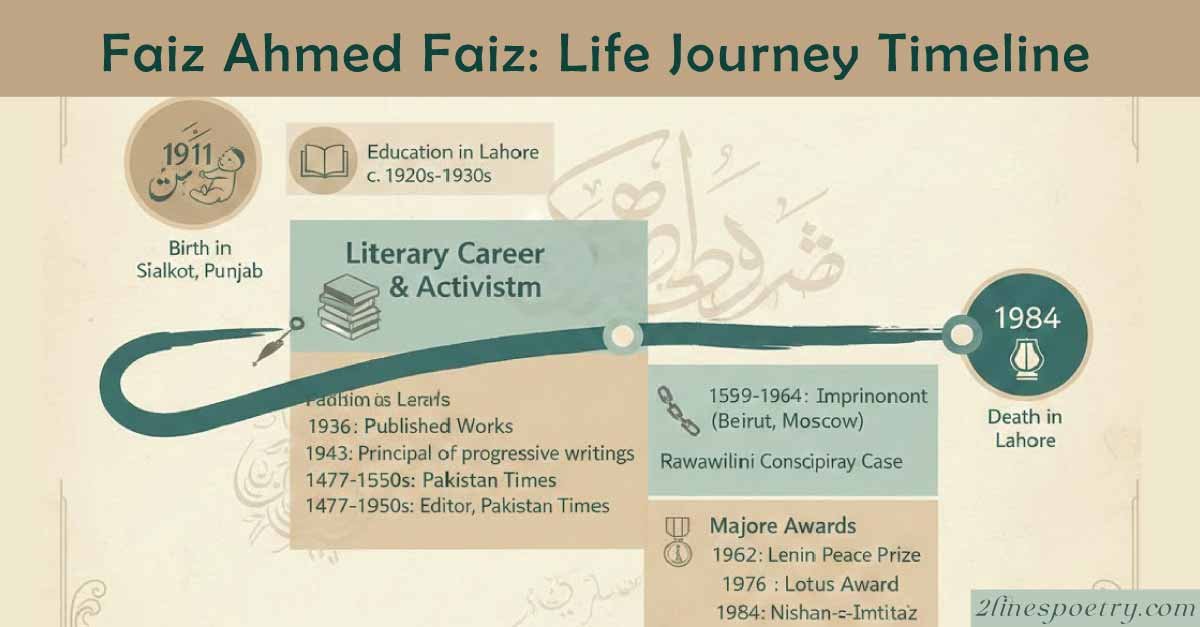
Faiz was born on the 13th of February 1911, in the city of Sialkot, which had already given birth to literary giants such as Allama Iqbal. His childhood surroundings were important in influencing his intellectual perspective. Sultan Muhammad Khan, his father was an educated man and acted as a lawyer and had a close association with the Arabic and Persian scholars. This introduced Faiz to a youthful acquaintance with classics and profound philosophical customs.
Faiz was first educated in Sialkot and went on to Lahore where he attended Government College at first and then Oriental College. The degrees he received in Arabic and English literature contributed to his creation of a very uncommon equilibrium between the Eastern poetic tradition and the Western literary concept. This was to be mixed up later to form one of the classifications of his poetry.
Faiz was already a questioning and an anti-authoritarian mind even when he was a student and even though he was the one who was the sympathizer of the oppressed. To him literature was never ornamental, but a means of knowing the society and questioning injustice.
Entry into Literature and Journalism
Faiz started writing in the 1930s which was a time of great political and social transformation in the Indian sub continental region. Thinking of many young writers was affected by colonial rule, economic inequality and increased political awareness. Faiz joined the Progressive Writers Movement which considered that people needed to mirror social reality in literature and to struggle toward human liberation. Meanwhile, Faiz was a teacher and thereafter a participant in journalism.
He worked as an editor in Pakistan Times and was as well involved with Imroze. It was journalism that enabled him to be more politically conscious and one that brought him nearer to the lives of the common people. Such experiences enhanced his social consciousness that was to be the theme of his poetry.
Faiz and Progressive Ideology
It is impossible to separate the ideology of Faiz and his art. He was a person who was a strong believer in social justice, equality and human dignity. He was a follower of socialism and believed poetry was a moral duty and not a personal medicine. But the beauty is that Faiz never did give ideology a leeway and conquer beauty.
His poems are not written like political speeches. As an alternative, they are laden with metaphor, emotion and lyrical grace. Even at the moment when he talks about revolution, he does it in the language of love and desire. This balance was fine and enabled Faiz to capture a lot of people who were not confined in the political sphere. His words do not leave indifferent those people who might disagree with his ideology.
Poetry of Love: Beyond Romance
The love poetry of Faiz is mistaken to be a purely romantic Love poetry. As a matter of fact, his love is multifaceted and wide spread. Love to Faiz is not a face that is lovingly seen or a hasty passion. It is closely related to the freedom, dignity and shared happiness. The beloved is frequently used as an image in his well-known verses as the dream of the just society. Separating is exiled, marrying is liberation, and desiring is resistance.
It is this personal feeling combined with social significance that makes the love poetry that Faiz has created so timeless. There is some quiet power in his voice even when he speaks about personal loss or emotional hurt, a refusal to give up hope.
Prison, Exile, and Silence
One of the most distinguishing periods in the life of Faiz was his imprisonment. In 1951, he was apprehended in relation to the Rawalpindi Conspiracy Case in which he was alleged to have conspired against the government. He spent a number of years in prison which greatly affected his poetry. The jail made him a more humane man instead of destroying the spirit.
Patience, dignity and resistance within are characteristic of his prison poetry. He talks of chains, and darkness and waiting, but never bitterly. There are sad things, but there are good things. It hurts, yet it believes that there will be dawn. Faiz also spent his life in exile later in life mostly in Beirut.
His poetry was very much tied to the people and the land that he loved even in the absence of home. Another metaphor that he employed in his work was exile, which was a symbol of being out of touch with justice, peace, and belonging.
Major Poetry Collections
Faiz’s poetry collections reflect the evolution of his thought and emotion. Some of his most notable works include:
- Naqsh-e-Faryadi
- Dast-e-Saba
- Zindan Nama
- Dast-e-Tah-e-Sang
- Sar-e-Wadi-e-Seena
Each collection is a new stage in his life, one of the period of youthful idealism, another of mature thought. The only thing that is constant is his mastery of language and how he is able to transform misery into art.
Faiz Ahmed Faiz Famous Poetry:
“محبت”
“چاندنی رات میں تنہا میں سوچ رہا ہوں
تیری یاد کے سائے کو گلے لگا رہا ہوں
دل کی بستی میں جو بھی ہوا ہے، تمہاری محبت ہے
میری خاموشی میں تمہارا عکس جا رہا ہے”
This lines where the ghazal is involved displays the skill of Faiz in terms of mixing love and longing. He describes love as console and haunting. The poem is a mirror of the inner world of desire, where one can feel the presence of the beloved even in the silence and loneliness.
“زنجیر اور امید”
“زنجیر نے روکے قدم مگر دل نہ رکا
اندھیرا چھا گیا مگر روشنی ابھی باقی ہے
قید خانہ میں بھی امید کی چھاؤں ہے
آزادی کا نغمہ ہر سانس میں گونج رہا ہے”
The poem is a symbol of resistance to the oppression. Faiz focuses on the fact that the spirit cannot be restrained by physical restraint. Not even darkness or imprisonment cannot stop him as hope is present, which demonstrates his faith in inner freedom and the eternal strength of resilience and courage.
“بول کہ لب آزاد ہیں تیرے”
“بول کہ لب آزاد ہیں تیرے
بول زباں اب تک تیری ہے
تیرا ستواں جسم ہے تیرا
بول کہ جاں اب تک تیری ہے”
This is a legendary poem that advocates on telling truth about injustices. Faiz also tells the reader that in spite of oppression, it should not dispossess their voice. Being free is being expressive and telling the truth is a courageous and honorable thing to do.
Why Faiz Still Speaks to the Youth
Decades after his death. His verses are posted online in universities, cultural events, and on the same level as ever. It is just a matter of fact because his poetry addresses confusion, injustice, and hope which never grows old. Faiz provides a language of pride in the world where young people can feel unheard and powerless. He preaches that, resistance is poetic, that being weak is actually being soft and that dreaming about change is a revolutionary act.
Language, Style, and Symbolism
The language used by Faiz is high but not difficult. He heavily relies on the classical tradition of Urdu but brings about a sense of modernity to it. His comparisons, night, dawn, chains, flowers, wounds are very plain and symbolic at the same time. The fact that his poetry does not need intellectual elitism is one of the reasons why Faiz is still popular among readers. An ordinary reader is able to feel it, a scholar is able to analyze it infinite.
This corruption-innocence is rare and strong. His fashion is musical and that is the reason why a lot of his poems were transformed into songs. When he sings, his words are made to live another life by being heard by those who might never read a book of poetry.
Influence on Music, Culture, and Resistance
The poetry of Faiz has strongly impacted on the South Asian culture. His poems have been re sung by such great singers as Noor Jehan, Mehdi Hassan, Iqbal Bano and many others. His ideas were transported to the homes, streets, and hearts with the help of these musical interpretations. In addition to music, it is also evident that Faiz has impacted student movements, literature groups, and political rhetoric. His poems are also read in demonstrations and meetings that require justice. His words still bring courage to the oppressed even decades after his demise.
International Recognition
Faiz was not the only one who was admired in Pakistan and India but also respected in the whole world. In 1962, he won the Lenin Peace Prize and was read extensively in the Soviet Union, Middle East and Europe. His stay in Beirut also saw him in contact with other world writers and thinkers only increasing his influence. Faiz was a humble and an individual who was very strong with his cultural identity in spite of being famous internationally. To impress the world with his writing he never wrote, he wrote to be true to the conscience.
Legacy and Relevance Today
Faiz Ahmed Faiz had died on November 20, 1984, yet it has not forgotten him. His poetry is more topical than ever in an era of inequality, censorship, and war. He tells us that resistance does not need to be vociferous to be effective. How that love is political, without being less tender. That words when true written may live through kingdoms and silence. The legacy of Faiz cannot be limited to the world of literature or poetry fetes. It exists where people venture to hope, to question and even dream of a better world.
Conclusion
Faiz Ahmed Faiz was a poet of balance the rare, soft and fearless, romantic and revolutionary. Learning, struggle and exile were the influences of his life and his poetry made something out of it that was lasting and beautiful. Reading Faiz is not merely reading poetry but history, humanity and conscience. His words still set the lights during the dark moments to remind us how a human soul can sing even in chains.
☝️ Allama Iqbal – Life, Poetry, Philosophy & Legacy explores the journey of Pakistan’s national poet, his inspiring poetry, deep philosophy, and timeless influence. Discover how his thoughts shaped generations and continue to inspire millions. Read the full post to understand the profound wisdom, literary genius, and visionary ideas of Allama Iqbal that make him truly unforgettable.

Hassan Nigaar is an Urdu poetry writer and literary content creator with a strong interest in both creative and educational aspects of Urdu literature. Along with writing and curating 2-line Urdu poetry, he also creates informative content on learning poetry techniques and explores the lives and works of famous Urdu poets. Through 2LinesPoetry.com, his goal is to promote Urdu poetry, literary awareness, and cultural appreciation for readers around the world.