
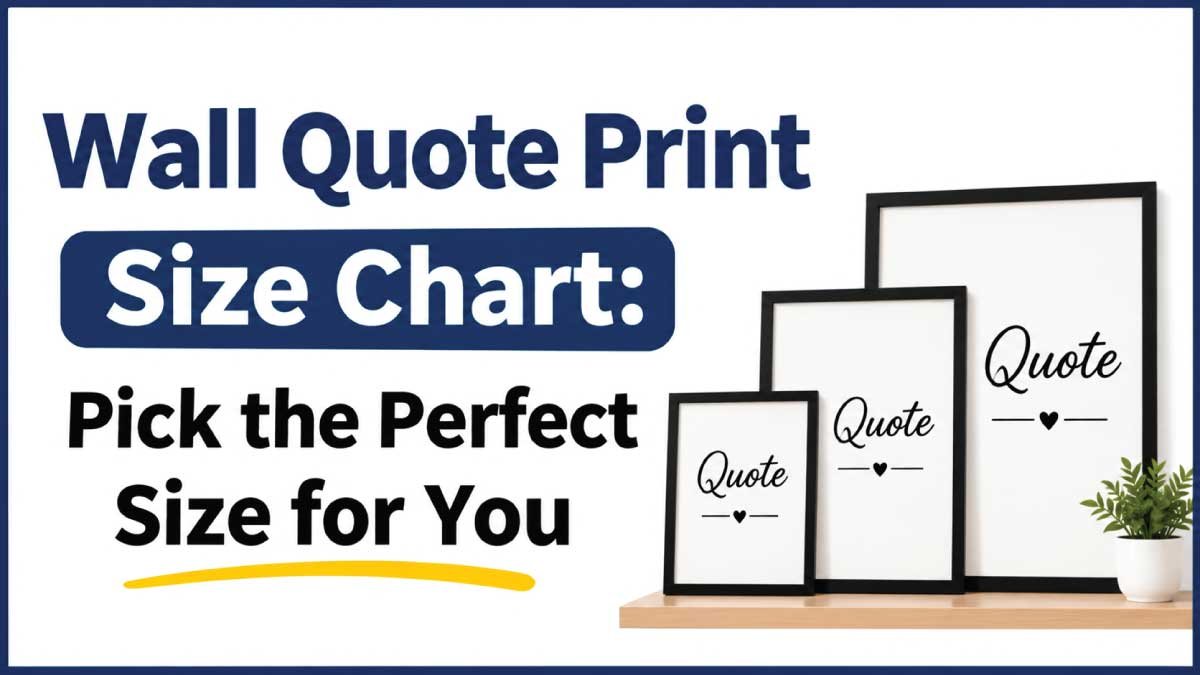
Choosing the right size for a wall quote print can make the difference between a design that looks polished and one that feels too small, crowded, or out of proportion. A quote may look perfect on a computer screen but appear very different once it is printed, framed, and placed on a real wall.
A wall quote print size chart helps you compare common print dimensions before ordering or designing your artwork. It can also help you decide how much wall space to cover, what frame size to use, and whether a quote should be displayed alone or as part of a gallery wall.
This guide explains common wall quote print sizes, how to measure your space, how to choose the right dimensions, and what to consider when printing and framing quote artwork.
What Is a Wall Quote Print Size Chart?
A wall quote print size chart is a reference showing common print dimensions used for quote artwork and decorative wall prints. Sizes are usually listed by width × height, such as 8 × 10 inches or 18 × 24 inches.
The chart does not represent one universal standard for wall quotes. Print sizes can vary by:
- Printer
- Paper supplier
- Frame availability
- Design format
- Country or measurement system
- Portrait or landscape orientation
- Custom printing requirements
Instead, a size chart provides practical dimensions that make it easier to compare options.
For example, a small motivational quote designed for a desk area may work well at 8 × 10 inches, while a large statement quote above a sofa may need a substantially larger print.
The most important point is that the best size depends on the wall, furniture, viewing distance, quote length, and overall design.
Common Wall Quote Print Sizes
There are many possible print dimensions, but certain sizes are especially convenient because matching frames are widely available.
The following chart provides practical reference sizes. These are common print formats rather than mandatory industry standards.
| :—: | :—: | :—: | :—: |
| Print Size | Orientation | Approx. Area | Typical Use |
|---|---|---|---|
| 5 × 7 in | Portrait/Landscape | 35 sq in | Small decorative areas |
| 8 × 10 in | Portrait/Landscape | 80 sq in | Bedroom, desk, shelf |
| 8.5 × 11 in | Portrait | 93.5 sq in | Home office, small wall |
| 11 × 14 in | Portrait/Landscape | 154 sq in | Bedroom or hallway |
| 12 × 16 in | Portrait/Landscape | 192 sq in | Medium wall display |
| 16 × 20 in | Portrait/Landscape | 320 sq in | Living room or office |
| 18 × 24 in | Portrait/Landscape | 432 sq in | Large statement print |
| 20 × 30 in | Portrait/Landscape | 600 sq in | Large wall or focal area |
| 24 × 36 in | Portrait/Landscape | 864 sq in | Large statement artwork |
These sizes are useful starting points, but they should not be selected without considering the wall and surrounding objects.
For example, a 24 × 36-inch print can look excellent on a large empty wall but overwhelming in a narrow hallway.
Small Wall Quote Print Sizes
Small prints are useful when the quote is intended to complement other decorative elements rather than dominate the wall.
Common smaller choices include:
- 5 × 7 inches
- 8 × 10 inches
- 8.5 × 11 inches
- 11 × 14 inches
An 8 × 10-inch quote can work particularly well on a bedside wall, office shelf, reading corner, or small section of wall.
Small prints are also useful for gallery walls. Several different quotes, photographs, illustrations, or decorative pieces can be arranged together without requiring one large artwork to fill the entire space.
However, quote readability becomes important at smaller sizes. A long sentence with decorative lettering may become difficult to read when reduced too far.
Medium Wall Quote Print Sizes
Medium prints offer a balance between visibility and flexibility.
Common options include:
- 12 × 16 inches
- 16 × 20 inches
- 18 × 24 inches
These dimensions can work well for a single quote in a bedroom, home office, hallway, dining area, or smaller living room.
A medium print is often easier to design because it provides enough space for larger typography without requiring an enormous wall.
For longer quotes, a larger medium format can also give the designer room to use comfortable spacing between lines.
Large Wall Quote Print Sizes
Large quote prints are intended to act as a focal point.
Common larger formats include:
- 20 × 30 inches
- 24 × 36 inches
- Custom larger dimensions
These sizes can work above sofas, beds, desks, consoles, or other large pieces of furniture.
A large quote print should have enough visual breathing room. Filling a large canvas with tiny lettering simply because there is space available does not necessarily create a better design.
Instead, use the additional space to improve:
- Typography
- Line spacing
- Margins
- Visual balance
- Readability
- Overall composition
A short, powerful quote can sometimes look better on a large print than a long paragraph squeezed into the same area.
How to Choose the Right Wall Quote Print Size
Choosing a print size should start with the space where the artwork will be displayed.
Before selecting dimensions, consider the wall width, furniture below the artwork, viewing distance, quote length, and whether other decorations will be nearby.
Measure the Available Wall Space
Use a tape measure to determine the approximate width and height available.
Do not measure only the empty wall. Consider nearby doors, windows, shelves, lamps, furniture, and other artwork.
If the print will hang above furniture, measure the furniture as well. The artwork should feel visually connected to the object beneath it rather than appearing randomly placed.
Consider the Furniture Width
A large wall does not always require a large print.
If a quote is being placed above a sofa, bed, console, or desk, the furniture often provides a useful reference point for determining the artwork’s visual scale.
For example, a relatively small print may look lost above a wide sofa, while an oversized print can make a narrow console look visually unbalanced.
The goal is proportion, not simply maximum size.
Think About Viewing Distance
A quote should remain readable from the distance at which people normally see it.
A print viewed from several feet away needs typography that is easier to recognize than a print viewed close to a desk.
This is especially important for:
- Inspirational quotes
- Long quotations
- Small secondary text
- Handwritten fonts
- Thin decorative lettering
If readability is a priority, increasing the print size can provide more room for comfortable typography.
Wall Quote Print Size Chart by Room
Different rooms often have different space and viewing requirements.
The following chart provides general starting points rather than fixed rules.
| :—: | :—: | :—: | :—: |
| Room/Area | Small Option | Medium Option | Large Option |
|---|---|---|---|
| Bedroom | 8 × 10 in | 12 × 16 in | 18 × 24 in |
| Home Office | 8.5 × 11 in | 12 × 16 in | 16 × 20 in |
| Hallway | 5 × 7 in | 11 × 14 in | 16 × 20 in |
| Living Room | 11 × 14 in | 16 × 20 in | 20 × 30 in |
| Above Bed | 12 × 16 in | 18 × 24 in | 24 × 36 in |
| Above Desk | 8 × 10 in | 12 × 16 in | 16 × 20 in |
| Gallery Wall | 5 × 7 in | 8 × 10 in | 11 × 14 in |
These categories are simply practical starting points. A room with unusually high ceilings or a large open wall may require a different approach.
Portrait vs. Landscape Wall Quote Prints
The same print dimensions can create a completely different visual effect depending on orientation.
Portrait Orientation
Portrait prints are taller than they are wide.
They work well for:
- Tall walls
- Narrow spaces
- Door-side areas
- Vertical quotes
- Designs with several short lines
A portrait format can also help create a stronger vertical visual flow.
Landscape Orientation
Landscape prints are wider than they are tall.
They can work particularly well:
- Above sofas
- Above desks
- Above consoles
- On wide horizontal walls
- With short quotes arranged across several lines
For a long quote, landscape orientation can sometimes reduce excessive line breaks.
The best orientation depends on both the quote and the location.
Also Read:
How Quote Length Affects Print Size
The amount of text is one of the most important factors when choosing a wall quote print size.
A short quote such as a few words can work beautifully on a relatively large print because the typography can remain bold and spacious.
A long quote requires more careful planning.
If you try to fit too much text into a small print, you may need to reduce the font size. That can hurt readability and make the artwork look crowded.
For longer quotations, consider:
- A larger print
- More generous margins
- Fewer decorative elements
- A simple font
- Shorter line lengths
- Clear separation between text sections
Do not assume that every quote should fill the entire printable area. Empty space is part of the design.
Also Read:
Print Size vs. Frame Size
One common source of confusion is the difference between the print dimensions and the overall framed dimensions.
If a print is listed as 16 × 20 inches, that generally refers to the artwork or paper size. A frame can make the finished wall piece larger because of its outer dimensions.
A mat or mount can also affect the final presentation.
What to Check Before Ordering
Before purchasing a frame, confirm:
- The actual print dimensions
- Whether the listed frame size refers to the opening or outer edge
- Whether a mat is included
- Whether the frame accepts the paper thickness
- Whether the artwork is designed for portrait or landscape orientation
This prevents the common mistake of buying a frame that appears to have the right dimensions but does not properly fit the artwork.
Common Paper and Print Ratios
Print dimensions are not all based on the same aspect ratio.
This matters because an image created for one proportion may need to be cropped to fit another size.
For example, artwork designed for a rectangular format may lose part of its composition when forced into a different shape.
Before printing, check the relationship between the artwork’s width and height.
If a design needs to be resized significantly, avoid simply stretching it. Stretching can distort lettering, illustrations, borders, and other design elements.
Instead, resize the artwork proportionally or redesign the layout for the new dimensions.
Digital File Size and Print Quality
A wall quote can look sharp on a phone or computer while still producing poor results when printed at a large size.
Print quality depends on the source file, dimensions, typography, and printing process.
For larger prints, make sure the artwork is created at a suitable resolution for the intended physical size.
Why Resolution Matters
When a small digital image is enlarged significantly, edges can become soft or pixelated.
This is particularly noticeable around:
- Small text
- Thin lines
- Decorative borders
- Icons
- Detailed illustrations
For quote artwork, typography should remain clean and crisp.
If you are creating the artwork yourself, set the document to the intended print dimensions before designing whenever possible. This makes it easier to judge text size, spacing, and composition accurately.
How to Measure for a Wall Quote Print
Accurate measurements can prevent many sizing mistakes.
Step 1: Measure the Wall
Measure the usable width and height of the area where the artwork will go.
Step 2: Measure Nearby Furniture
If the print will sit above furniture, measure the furniture’s width and height.
Step 3: Mark the Intended Area
Use removable painter’s tape to outline the approximate print dimensions on the wall.
This is one of the easiest ways to visualize scale before buying or printing artwork.
Step 4: Step Back
Look at the taped outline from different parts of the room.
Check whether it feels:
- Too small
- Too large
- Too narrow
- Too wide
- Properly balanced
Step 5: Consider the Frame
Remember that the final framed piece can be larger than the paper itself.
This simple measuring process is often more reliable than choosing a size based only on a product photograph.
Wall Quote Size for Gallery Walls
Gallery walls require a different approach because the quote print is part of a larger composition.
A quote can act as:
- A central statement
- A secondary piece
- A small accent
- One of several similarly sized prints
Smaller formats such as 5 × 7, 8 × 10, and 11 × 14 inches can work well in collections, but there is no requirement that every piece have identical dimensions.
The important factors are spacing, alignment, visual weight, and consistency.
For example, several differently sized prints can look intentional when their outer edges or center lines are carefully aligned.
Before drilling holes, arrange the artwork on the floor or create paper templates and position them on the wall.
Common Wall Quote Printing Mistakes
Even a good quote design can look disappointing if the print size or preparation is wrong.
Choosing a Size Without Measuring
Buying artwork first and trying to find a place for it later can lead to poor proportions.
Measure the intended location before selecting the print.
Ignoring the Frame
The paper may fit perfectly while the finished frame looks too large for the available space.
Always consider the complete finished piece.
Using Too Much Text
Long quotes do not always need large amounts of decorative text.
Too many words, fonts, ornaments, and colors can make the design difficult to read.
Using a Small Font on a Large Wall
Increasing the paper size does not automatically make the quote readable.
Typography should be appropriate for the intended viewing distance.
Stretching the Artwork
Never distort the proportions simply to force a design into an incompatible print size.
Resize proportionally or adjust the layout.
How to Make a Wall Quote Look More Professional
Good wall quote design is usually about restraint.
A professional-looking print often benefits from:
- One or two complementary fonts
- Strong contrast between text and background
- Consistent margins
- Adequate line spacing
- Simple decorative elements
- Clear visual hierarchy
- Enough empty space
The quote itself should remain the main focus.
If the words are inspirational, meaningful, or intended to create a particular mood, the design should support the message rather than compete with it.
Frequently Asked Questions
What is the most common size for a wall quote print?
There is no single universal size. Common practical formats include 8 × 10, 11 × 14, 12 × 16, 16 × 20, and 18 × 24 inches. The best option depends on the wall and intended display.
What size quote print is best above a sofa?
A medium or large landscape-oriented print often works well above a sofa, but the correct size depends on the sofa’s width, wall dimensions, and surrounding décor. Measure the area before choosing.
Is 8 × 10 a good size for wall art?
Yes. An 8 × 10-inch print is versatile for bedrooms, offices, shelves, small walls, and gallery arrangements. It may be too small for a large empty wall.
What size should a quote be above a bed?
Medium to large formats can work well above a bed, particularly when the wall is wide. Options such as 18 × 24 or 24 × 36 inches may provide stronger visual presence, depending on the room.
Should wall quote prints be portrait or landscape?
Either orientation can work. Portrait is useful for narrow or tall spaces, while landscape can work well above wide furniture. Let the wall and quote composition determine the orientation.
Does frame size include the print size?
Frame listings can use different measurements, so check the manufacturer’s specifications. Some measurements refer to the artwork opening, while others refer to the frame’s outside dimensions.
What print size is best for a long quote?
A larger print can make a long quote easier to read because it provides more room for typography and spacing. However, the quote should not be reduced to an unnecessarily small font just to fit a particular format.
Can I print a small digital quote at a large size?
It depends on the quality and dimensions of the original file. Enlarging a low-resolution image too much can produce pixelation or soft edges. A properly prepared high-resolution file is preferable.
How do I know if a wall quote is too small?
Place a paper or tape outline of the proposed size on the wall and view it from normal standing and sitting positions. If it visually disappears against the wall or surrounding furniture, a larger format may work better.
Conclusion
The right wall quote print size depends on more than the dimensions of the artwork itself. Wall space, furniture, viewing distance, quote length, orientation, framing, and typography all affect the final result.
Use a wall quote print size chart as a starting point rather than a strict rule. Smaller formats are useful for compact areas and gallery walls, while medium and large prints can create stronger focal points in larger rooms.
Before printing, measure the wall, consider the finished frame, check the artwork’s proportions, and make sure the text remains easy to read. A well-sized quote print should feel balanced within its surroundings while giving the message enough space to stand out.