
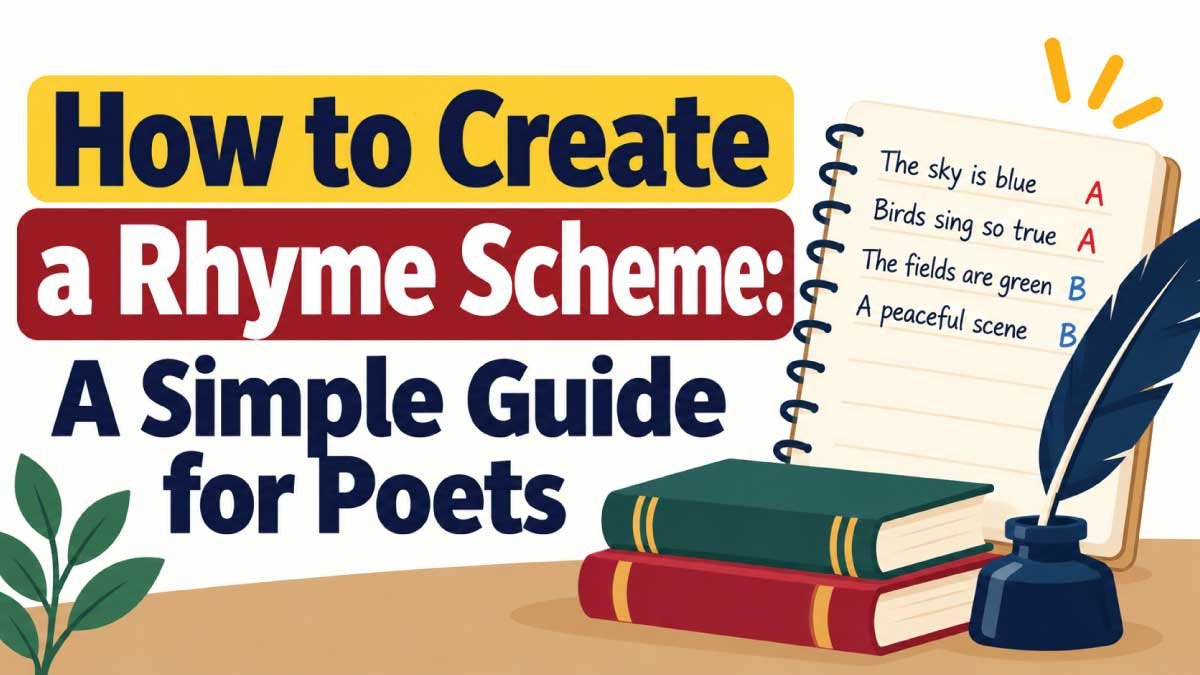
A rhyme scheme gives a poem a recognizable pattern by showing which lines rhyme with one another. If you are learning how to create a rhyme scheme, the basic idea is simple: look at the ending sounds of your lines and assign letters to matching sounds. Lines that rhyme receive the same letter, while different sounds receive different letters.
For example, if the first and third lines rhyme and the second and fourth lines rhyme, the pattern is ABAB. Once you understand this system, you can identify rhyme patterns in existing poems and deliberately create your own.
This guide explains how rhyme schemes work, how to label them, common rhyme patterns, how to build one from scratch, and how to avoid forcing rhymes that make your poetry sound unnatural.
What Is a Rhyme Scheme?
A rhyme scheme is the pattern of rhyming sounds at the ends of lines in a poem. It is usually represented with letters such as A, B, C, and D.
The first distinct end rhyme is labeled A. If the next line ends with a different rhyme, it receives B. If a later line returns to the first rhyme, it receives A again.
Consider this simple example:
The morning sun begins to glow.
A quiet breeze moves through the tree.
The golden clouds drift soft and slow.
The world wakes gently, wild and free.
The ending sounds are:
- glow — A
- tree — B
- slow — A
- free — B
So the rhyme scheme is ABAB.
The letters do not represent specific sounds. They simply help readers and writers see the relationship between rhyming lines.
Why Do Poets Use Rhyme Schemes?
A rhyme scheme can give poetry structure, rhythm, musicality, and a sense of completion. It can also make lines easier to remember.
Depending on the pattern, rhyme can create different effects:
Simple patterns can make poems sound familiar and accessible.
Alternating patterns can create movement and balance.
Couplets can make ideas feel complete or emphatic.
More complex patterns can create tension and surprise.
Irregular patterns can make a poem feel conversational or unpredictable.
A rhyme scheme is therefore more than a decorative feature. It can influence how a poem sounds and how its ideas unfold.
How Does a Rhyme Scheme Work?
Creating a rhyme scheme starts with listening to the final stressed sounds of your lines rather than simply looking at the spelling of the final words.
For example:
The moon is shining bright.
We walk beneath the sky.
The stars are glowing bright.
The clouds are drifting by.
The pattern is ABAB because bright rhymes with bright, while sky rhymes with by.
The important point is that rhyme is based primarily on sound, not spelling. Words such as blue and through look different but rhyme. Meanwhile, words can look similar while having different pronunciations.
The Basic Lettering System
When identifying a rhyme scheme, follow this simple process:
- Look at the final word or sound in the first line.
- Give that sound the letter A.
- Look at the ending of the second line.
- If it rhymes with line one, label it A. If not, label it B.
- Continue through the stanza.
- Give matching rhyme sounds the same letter.
For example:
A bird flies high above the tree.
The river moves beneath the sun.
Its wings are wide and free.
The evening slowly has begun.
The pattern is ABAB.
Common Rhyme Scheme Patterns
Learning the most common rhyme schemes makes it much easier to recognize patterns and experiment with your own poetry.
AABB: Rhyming Couplets
In an AABB pattern, the first two lines rhyme with each other, followed by another pair.
The rain falls softly through the night.
The windows shimmer in the light.
The morning waits beyond the door.
And soon the clouds will rain no more.
The pattern is:
A — night
A — light
B — door
B — more
This structure is common in songs, children’s poetry, humorous poems, and narrative poetry.
ABAB: Alternating Rhyme
The ABAB pattern alternates between two rhyme sounds.
The leaves are dancing in the air.
A golden path extends below.
The autumn sunlight warms the square.
While distant hills begin to glow.
The first and third lines rhyme, while the second and fourth lines rhyme.
ABAB is especially useful when you want a stanza to feel balanced without making every neighboring line rhyme.
ABBA: Enclosed Rhyme
An ABBA pattern surrounds the middle two lines with the same rhyme.
The evening settles on the town.
The streets become both calm and clear.
A quiet stillness gathers near.
The final light begins to drown.
Here, the first and fourth lines rhyme, while the second and third lines rhyme.
This pattern is sometimes called enclosed rhyme because the A rhyme encloses the B rhyme.
AAAA: Monorhyme
In an AAAA scheme, every line in the stanza ends with the same rhyme.
The river carries stories long.
The wind replies with quiet song.
The trees lean gently all night long.
The stars above continue strong.
This can create a strong musical effect, although using the same rhyme repeatedly can become predictable if the poem is long.
ABCABC: Repeating Six-Line Pattern
Some poems use more extended patterns. In ABCABC, the first three rhyme sounds return in the same order in the next three lines.
This type of structure can create a strong sense of organization while giving the poet more freedom than a simple couplet.
How to Create a Rhyme Scheme Step by Step
If you want to create your own rhyme scheme rather than simply identify one, start with the structure and then develop the poem around it.
Step 1: Decide What Your Poem Is About
Choose a clear subject or emotional focus before worrying about rhyme.
You might write about:
- Friendship
- Nature
- Hope
- Memories
- Family
- A difficult experience
- A peaceful morning
- Growing older
- Dreams
- Love
Having a central idea makes it easier to choose meaningful words later.
Step 2: Choose a Basic Pattern
If you are new to rhyme, begin with a manageable pattern such as AABB or ABAB.
For example, suppose you choose ABAB.
That means:
- Line 1 = A
- Line 2 = B
- Line 3 = A
- Line 4 = B
You now know that lines one and three need compatible ending sounds, while lines two and four need another compatible sound.
Step 3: Choose Your Key Rhyme Words
Instead of writing complete lines and desperately searching for a rhyme afterward, choose a few possible ending words.
Suppose your subject is hope.
You might select:
A: light / night / bright / sight
B: way / day / stay / away
You can then build ideas around those words.
This approach gives you a framework without forcing every sentence to follow a predetermined phrase.
Step 4: Write the First Draft
Now write lines that communicate your idea while fitting the selected pattern.
For example:
A little hope can bring the light,
When clouds have covered up the day.
It helps us keep our vision bright,
And find another hopeful way.
The pattern is ABAB.
Notice that the rhyme supports the meaning rather than replacing it.
Step 5: Read the Poem Aloud
Reading your poem aloud is one of the best ways to test a rhyme scheme.
A rhyme can look perfect on the page but sound awkward when spoken.
Ask yourself:
- Do the rhymes sound natural?
- Is the rhythm comfortable?
- Does the poem feel musical?
- Does one line sound like it was written only to create a rhyme?
- Are the same words or sounds being repeated too often?
Your ear can often detect problems that are difficult to see while silently reading.
How to Choose Rhyming Words Without Forcing the Poem
One of the biggest challenges when creating a rhyme scheme is avoiding forced rhyme.
A forced rhyme occurs when a poet chooses an unnatural word or awkward sentence simply because it rhymes.
For example, if your poem is about grief and your carefully developed idea requires a particular word, changing the meaning just to rhyme can weaken the poem.
Start With Meaning, Then Refine the Rhyme
Instead of thinking:
“What word rhymes with this?”
Try asking:
“What am I actually trying to say?”
Write several possible versions of the line first. Then look for a natural rhyme.
You can also change the sentence structure rather than abandoning the idea.
Use a Rhyme Family
A rhyme family is a group of words that share a similar ending sound.
For example:
- light
- night
- bright
- sight
- flight
- right
Or:
- rain
- train
- pain
- gain
- again
- remain
Having several options gives you flexibility and helps prevent repetitive wording.
Do Not Always Choose the Most Obvious Rhyme
If you repeatedly use predictable pairs such as day/way or night/light, the poem may begin to sound familiar in a negative way.
Sometimes a less obvious but natural rhyme gives a poem more personality.
The goal is not to make every rhyme surprising. The goal is to make each rhyme feel intentional.
Also Read:
Perfect Rhyme vs. Slant Rhyme
Not every poem needs perfect rhymes.
Understanding different types of rhyme can give you more creative freedom.
Perfect Rhyme
A perfect rhyme occurs when the stressed vowel and sounds following it match.
Examples include:
- light / night
- stone / known
- dream / stream
- sky / high
Perfect rhyme produces a clear relationship between words.
Slant Rhyme
A slant rhyme, also called an imperfect or near rhyme, uses words with similar but not identical sounds.
Examples can include word pairs that share some consonant or vowel sounds without matching perfectly.
Slant rhyme can be useful when perfect rhymes feel too obvious or restrictive.
It is particularly valuable in modern poetry because it allows the poet to create sound relationships without making the poem feel overly patterned.
Why Use Different Types of Rhyme?
Using a mixture of perfect and near rhymes can make a poem sound more natural.
The choice depends on the effect you want:
| Rhyme Type | Basic Effect | Useful For |
|---|---|---|
| Perfect rhyme | Clear and musical | Traditional poems, songs |
| Slant rhyme | Subtle and flexible | Modern or reflective poetry |
| Internal rhyme | Adds sound within lines | Musical and rhythmic poems |
| End rhyme | Creates line-ending patterns | Structured poetry |
How to Create a Rhyme Scheme That Sounds Natural
A good rhyme scheme should support the poem instead of controlling it completely.
Keep the Meaning More Important Than the Rhyme
A beautiful rhyme cannot rescue a weak idea.
If a rhyme forces you to use a word that changes the intended meaning, reconsider the rhyme.
The reader should feel that the poet chose the word because it belonged in the poem—not simply because it happened to rhyme.
Vary Your Sentence Structure
Using the same grammatical structure repeatedly can make a poem sound mechanical.
Instead of making every line follow the same construction, vary sentence length and phrasing while keeping the rhyme pattern consistent.
Pay Attention to Rhythm
Rhyme and rhythm are related, but they are not the same thing.
A poem can have a perfect rhyme scheme and still sound awkward if its rhythm constantly interrupts natural speech.
Read each stanza aloud and listen for places where you have to force your voice to fit the line.
Avoid Too Many Obvious Rhymes
A poem does not become stronger simply because it contains more rhymes.
Sometimes fewer, better-placed rhymes create a more polished result.
Also Read:
Rhyme Scheme and Stanza Structure
A rhyme scheme often works together with the stanza, which is a group of lines separated from other groups in a poem.
For example, a four-line stanza might use:
ABAB
A poem with several four-line stanzas could repeat ABAB throughout, or each stanza could introduce a different pattern.
This gives poets several possibilities.
You might use:
- ABAB in every stanza for consistency.
- AABB for the first stanza and ABAB later.
- Different patterns to signal changes in mood.
- No rhyme in some sections and structured rhyme in others.
There is no universal rule requiring every poem to maintain one pattern from beginning to end.
The best structure depends on the poem’s purpose.
Also Read:
How to Identify the Rhyme Scheme of an Existing Poem
You can use the same system when analyzing someone else’s poem.
Start by writing down the final sound of every line.
For example:
The river moves beneath the moon.
The night is quiet, soft, and deep.
The birds will leave us very soon.
The sleeping hills are fast asleep.
Now compare the sounds:
- moon — A
- deep — B
- soon — A
- asleep — B
The rhyme scheme is ABAB.
What If a Line Does Not Rhyme?
Simply assign it a new letter.
Suppose the endings are:
light
stone
river
stone
The pattern would be:
A B C B
The third line does not need to rhyme just because the surrounding lines do.
This is an important part of rhyme analysis: label what actually happens rather than trying to make the poem fit a familiar pattern.
Common Mistakes When Creating a Rhyme Scheme
Beginners often make similar mistakes when learning how to create a rhyme scheme.
Forcing Words to Rhyme
If the sentence sounds unnatural, change the sentence or choose a different rhyme.
Ignoring Meaning
A poem should communicate something. Rhyme is a tool, not the entire purpose of the poem.
Confusing Spelling With Sound
Words do not need to look alike to rhyme. What matters is their pronunciation.
Using the Same Rhyme Too Long
A repeated rhyme can become predictable. Consider changing the pattern when the poem needs a new direction.
Forgetting Rhythm
Even a technically correct rhyme scheme can sound uncomfortable if the lines are difficult to speak naturally.
Changing the Pattern Accidentally
If you intend to write ABAB, check each stanza after drafting. An accidental change can either be an interesting creative choice or an unintended mistake.
Practical Tips for Better Rhyme Schemes
Once you understand the basics, these techniques can help you write stronger poems.
- Create a small rhyme bank before drafting.
- Read poetry aloud to test sound and rhythm.
- Use a dictionary or thesaurus carefully when you need alternatives.
- Avoid choosing a word solely because it rhymes.
- Experiment with near rhymes when perfect rhymes feel too obvious.
- Change the rhyme pattern when the poem’s mood or subject changes.
- Keep your central idea clear throughout the stanza.
- Revise after the first draft rather than expecting the first version to be perfect.
- Listen for repeated words and sounds that may become distracting.
- Let some lines breathe if strict rhyme is making the poem unnatural.
The strongest rhyme schemes usually feel effortless to the reader even though considerable thought may have gone into creating them.
Can a Poem Have No Rhyme Scheme?
Yes. Not every poem needs a rhyme scheme.
Free verse does not follow a fixed rhyme or meter pattern, although it can still contain occasional rhyme, repetition, rhythm, and other sound devices.
Poets may choose free verse when they want a more conversational, flexible, or natural structure.
A poem can also combine different approaches. For example, most of a poem may follow ABAB while another section uses unrhymed lines.
The absence of a fixed rhyme scheme is not a sign that a poem is incomplete. It is simply a different structural choice.
Frequently Asked Questions About Rhyme Schemes
What is the easiest rhyme scheme for beginners?
AABB is often easy to practice because each pair of lines shares a rhyme. ABAB is another excellent starting point because it teaches you to alternate between two rhyme sounds.
Does every poem need a rhyme scheme?
No. Poetry can use fixed rhyme, occasional rhyme, slant rhyme, internal rhyme, or no regular rhyme scheme at all.
How many lines should a rhyme scheme have?
There is no required number. A rhyme scheme can describe a two-line couplet, a four-line stanza, a sonnet, or a much longer poem.
Can the same word rhyme with itself?
Technically, repeating the exact same word does not create a new rhyme in the usual sense. It is generally more interesting to find different words that share the same ending sound.
Is ABAB better than AABB?
Neither is automatically better. ABAB creates alternating movement, while AABB gives paired lines a stronger sense of closure. Choose the pattern that suits your poem.
Can I change my rhyme scheme halfway through a poem?
Yes. A change can be effective when it reflects a shift in mood, subject, speaker, or structure. Just make sure the change feels intentional.
Do rhyming words have to be at the end of lines?
No. Internal rhyme occurs when rhyming words appear within the same line or across positions other than the line endings. However, end rhyme is what most basic rhyme-scheme notation describes.
A Simple Rhyme Scheme Practice Exercise
The fastest way to understand rhyme schemes is to create one yourself.
Start with this four-line structure:
Line 1 — A
Line 2 — B
Line 3 — A
Line 4 — B
Choose two rhyme families. For example:
A: rain, train, again, remain
B: light, night, bright, sight
Now write four lines around those words.
Do not worry about perfection on your first attempt. Focus on making the meaning clear and allowing the rhymes to sound natural.
After writing, check:
- Do lines one and three rhyme?
- Do lines two and four rhyme?
- Does the poem make sense?
- Does each line sound natural when spoken?
- Is the rhythm comfortable?
- Did you choose the words for their meaning as well as their sound?
If the answer to these questions is yes, you have successfully created a basic rhyme scheme.
Conclusion
Learning how to create a rhyme scheme becomes much easier once you understand the simple lettering system behind it. Start by identifying the ending sounds of your lines, assign the first sound A, and give matching sounds the same letter.
From there, experiment with familiar patterns such as AABB, ABAB, ABBA, and AAAA. Choose rhyme words that support your meaning, read your poem aloud, and revise any lines that feel forced.
Most importantly, remember that rhyme should serve the poem. A strong rhyme scheme can make poetry musical and memorable, but the best poems balance sound, rhythm, meaning, imagery, and emotion. Once you become comfortable with traditional patterns, you can also bend or break them intentionally to develop your own poetic voice.