
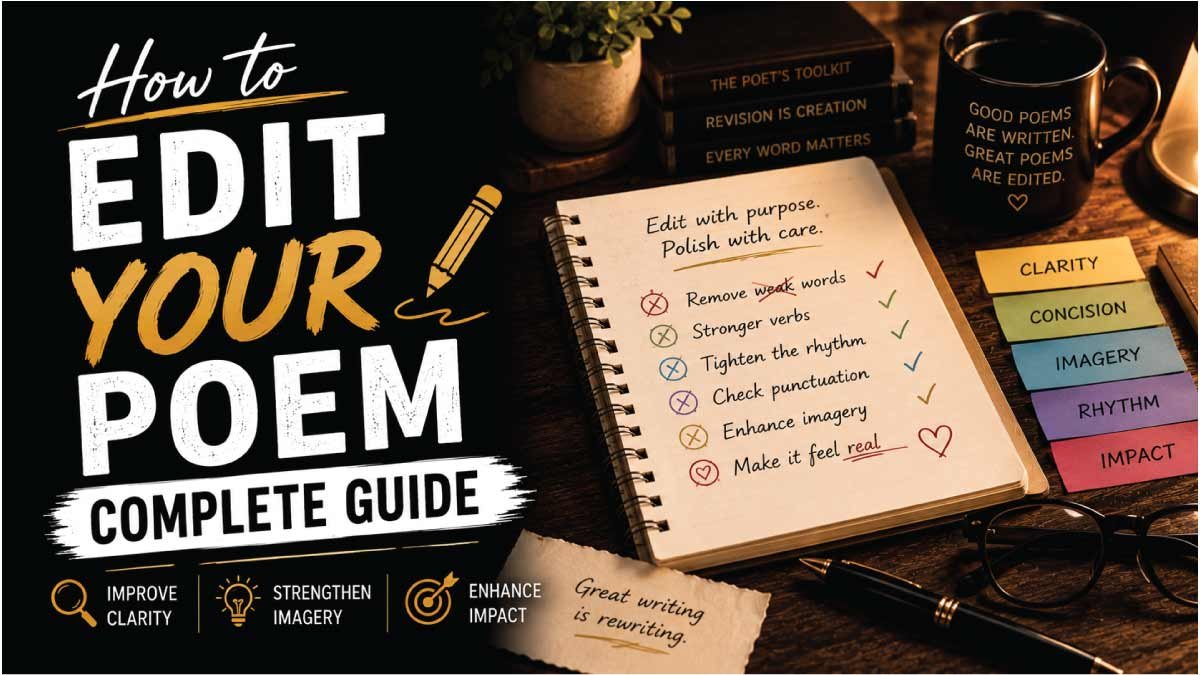
Writing a poem is only the first step. The real magic often happens during editing. Many beginner poets think a poem should be perfect immediately after writing it, but even experienced poets revise their work many times before sharing it with others.
Editing helps improve clarity, emotion, rhythm, imagery, and overall impact. A well-edited poem feels smoother, stronger, and more meaningful. Learning how to edit your poem can transform simple lines into powerful poetry.
In this guide, you will learn step-by-step techniques for editing poems effectively, even if you are a beginner.
Why Editing Is Important in Poetry
Poetry is built from carefully chosen words, where every line, pause, and image carries emotional weight. Editing is the process that transforms a raw draft into a powerful and polished poem. It helps poets refine their ideas, remove unnecessary elements, and strengthen the emotional impact of their writing.
Good editing helps you:
- Improve flow and rhythm
- Remove unnecessary words
- Create stronger imagery
- Clarify emotions
- Fix awkward lines
- Make poems more memorable
The first draft captures emotion, but editing shapes the poem into its best version.
Step 1: Take a Break Before Editing
One of the most effective editing techniques is stepping away from your poem for a while. When you write, emotions are still fresh, which can make it difficult to judge your work objectively. Distance helps you see your poem more clearly.
Take a break for:
- A few hours
- One day
- Several days
When you return, you will notice mistakes and weak lines more easily.
Step 2: Read the Poem Out Loud
Reading aloud is one of the most powerful editing methods in poetry. It helps you experience the rhythm, flow, and sound of your words in a more natural way.
When you hear your poem, you can notice:
- Awkward phrasing
- Repetitive words
- Weak rhythm
- Unnatural flow
- Missing emotions
If a line sounds uncomfortable while reading aloud, it likely needs revision.
Step 3: Focus on the Main Emotion
Every poem usually revolves around one central emotion or theme. Strong poetry maintains focus, ensuring that every line contributes to that emotional purpose.
Ask yourself:
- What emotion does this poem express?
- Does every line support that emotion?
- Are there unnecessary distractions?
If certain lines do not match the emotional focus, consider removing or rewriting them.
Step 4: Remove Unnecessary Words
Strong poetry is often simple and direct. Extra or repetitive words can weaken emotional intensity and reduce clarity. Editing helps make each line more precise and impactful.
Weak Example
The cold and freezing winter night was very dark.
Stronger Example
The freezing night swallowed the streets.
The second version feels cleaner and more powerful.
Step 5: Replace Weak Words With Stronger Ones
Choosing precise and vivid language is essential in poetry. Strong words create clearer images and deeper emotional resonance, while weak or general words reduce impact.
Instead of using general words like:
- Nice
- Sad
- Beautiful
- Bad
Use more descriptive alternatives:
- Hollow
- Radiant
- Shattered
- Golden
- Silent
- Trembling
Strong word choices improve emotional impact.
Step 6: Improve Imagery
Imagery is one of the most important elements in poetry because it allows readers to see, feel, and experience emotions instead of just reading about them. Strong imagery creates emotional depth and makes poems more memorable and powerful.
Instead of telling emotions directly, show them through images.
Weak Example
I felt lonely.
Better Example
The empty chair beside me stayed untouched all night.
The second line creates emotion through imagery rather than explanation.
Step 7: Check the Rhythm and Flow
Good poetry should feel natural and smooth when read aloud. Rhythm and flow affect how the poem sounds, how it is experienced, and how emotionally effective it becomes.
Pay attention to:
- Sentence length
- Word sounds
- Pauses
- Repetition
If the rhythm feels awkward, try:
- Rearranging words
- Breaking long lines
- Removing extra syllables
Even free verse poems benefit from natural flow.
Step 8: Avoid Forced Rhymes
Rhyme can make poetry musical, but forcing rhymes often weakens meaning and sounds unnatural. Strong poetry prioritizes emotion and clarity over forced sound patterns.
Forced Example
I sat beside the tree,
Thinking what life could be.
More Natural Example
I sat beneath the silent tree,
Watching evening slowly disappear.
Natural emotion matters more than perfect rhyming.
Step 9: Remove Clichés
Clichés are overused phrases that lose emotional strength because they appear too often in writing. Replacing them with original imagery makes poetry feel fresher and more meaningful.
Examples:
- Broken heart
- Cold as ice
- Tears like rain
- Lost in darkness
Original Version
My thoughts wandered like smoke through empty rooms.
Unique imagery makes poetry more memorable.
Step 10: Strengthen the Opening Line
The opening line of a poem is very important because it decides whether the reader continues or loses interest. A strong beginning should create curiosity, emotion, or atmosphere immediately.
Weak Opening
I was thinking about life yesterday.
Strong Opening
The night carried questions no stars could answer.
Powerful openings encourage readers to continue.
Also Read:
Step 11: Improve the Ending
The ending of a poem is where the final emotional impact is delivered. A strong conclusion stays in the reader’s mind and often gives the poem its lasting meaning.
Good endings often:
- Reveal insight
- Create reflection
- Leave emotional impact
- End with strong imagery
Avoid weak or rushed conclusions because they reduce emotional strength.
Step 12: Check Line Breaks Carefully
Line breaks are not just formatting—they control rhythm, pacing, and emotional emphasis. Proper line breaks can make a poem feel more dramatic, thoughtful, and powerful.
Breaking lines intentionally can strengthen meaning.
Example
She waited
for the sound of footsteps
that never came.
The pauses create emotional tension.
Step 13: Read the Poem Multiple Times
Editing is not a one-time process. A single reading is rarely enough to fully understand a poem’s strengths and weaknesses. Multiple readings help you analyze different layers of your writing, from emotion to structure.
Read your poem several times while focusing on different elements:
First Reading
Focus on emotion.
Ask yourself what feeling the poem creates and whether it feels authentic.
Second Reading
Focus on rhythm.
Check how smoothly the poem flows when read aloud.
Third Reading
Focus on imagery and word choice.
Look for strong images and replace weak or unclear words.
Fourth Reading
Focus on grammar and clarity.
Fix any mistakes that affect readability or understanding.
Each reading helps improve the poem further.
Step 14: Ask for Feedback
External feedback is valuable because other readers can notice issues you may overlook. Different perspectives help you understand how your poem is received emotionally and structurally.
Share your poem with:
- Friends
- Writing groups
- Poetry communities
- Teachers
Feedback can help identify:
- Confusing lines
- Weak sections
- Emotional impact
- Flow issues
However, always maintain your personal style and voice, even when making improvements based on feedback.
Also Read:
Step 15: Do Not Overedit
While editing improves poetry, overediting can sometimes reduce emotional power. Excessive polishing may remove the natural feeling, honesty, and spontaneity that make poetry meaningful in the first place.
Sometimes raw and imperfect lines carry strong emotional power.
Avoid making poems sound robotic or overly polished. The goal is balance—refining the poem while preserving its emotional authenticity.
Common Mistakes Beginners Make While Editing
Editing is an essential part of poetry writing, but many beginners unintentionally weaken their poems during the process. Understanding these common mistakes helps preserve emotional depth while still improving quality and clarity.
Editing Too Quickly
One of the biggest mistakes is editing immediately after writing. When emotions are still fresh, it becomes difficult to judge the poem objectively. Quick editing often leads to missing important issues or making unnecessary changes.
Immediate editing can make it harder to notice problems clearly.
Removing All Emotion
Some writers overedit their poems to the point where emotional honesty disappears. In trying to make the poem “perfect,” they accidentally remove the raw feeling that makes it meaningful.
Overediting can cause poems to lose emotional honesty.
Using Fancy Words Unnecessarily
Beginners often replace simple words with complex vocabulary, thinking it improves quality. However, overly complicated language can reduce emotional clarity and make the poem harder to connect with.
Simple language often creates stronger poetry.
Ignoring Sound and Rhythm
Poetry is not only about meaning—it is also about how it sounds when spoken aloud. Ignoring rhythm and flow can make even powerful poems feel weak or awkward.
Poetry should sound natural when spoken aloud.
Comparing Your Poems to Famous Poets
Comparing your early work to experienced poets can be discouraging. Every poet develops their voice over time, and improvement is a gradual process.
Every poet develops differently. Improvement takes time and practice.
Editing Checklist for Poems
Before finishing your poem, it helps to review key elements to ensure emotional strength, clarity, and flow. This checklist can guide your final editing stage.
Ask yourself:
- Does the poem express clear emotion?
- Are there unnecessary words?
- Does the imagery feel vivid?
- Does the poem flow naturally aloud?
- Are the opening and ending strong?
- Are the line breaks effective?
- Does every line contribute meaning?
This checklist can help improve your editing process.
Also Read:
Difference Between Revising and Editing
Many beginners confuse revising and editing, but both serve different purposes in improving poetry. Understanding the difference helps you structure your writing process more effectively.
Revising
Revising involves major changes such as:
- Rewriting lines
- Changing structure
- Adding or removing ideas
Editing
Editing focuses on smaller refinements such as:
- Fixing grammar
- Improving word choice
- Smoothing rhythm
Both are important for strong poetry.
Famous Poets Also Edited Their Work
Even great poets did not write perfect poems in a single attempt. They spent time revising and refining their work to improve clarity, rhythm, and emotional impact.
Writers like:
- Emily Dickinson
- Robert Frost
- Maya Angelou
spent time refining language, rhythm, and imagery before publishing.
Great poetry rarely appears perfectly in the first draft.
How Editing Improves Your Poetry Skills
Regular editing is not just about improving a single poem—it also helps you grow as a writer. Over time, editing trains your mind to recognize stronger language, better structure, and deeper emotional expression.
The more you edit, the better your writing becomes.
Final Thoughts
Learning how to edit your poem is one of the most important skills for becoming a better poet. Editing transforms rough ideas into meaningful and polished poetry. It helps strengthen emotions, improve rhythm, sharpen imagery, and remove unnecessary words.
The key to good editing is patience. Do not rush the process. Read your poem carefully, listen to how it sounds, and focus on making every word meaningful.
Remember that even professional poets revise their work many times. Writing the first draft is only the beginning. True poetic growth happens when you learn how to shape and refine your words with care.v