
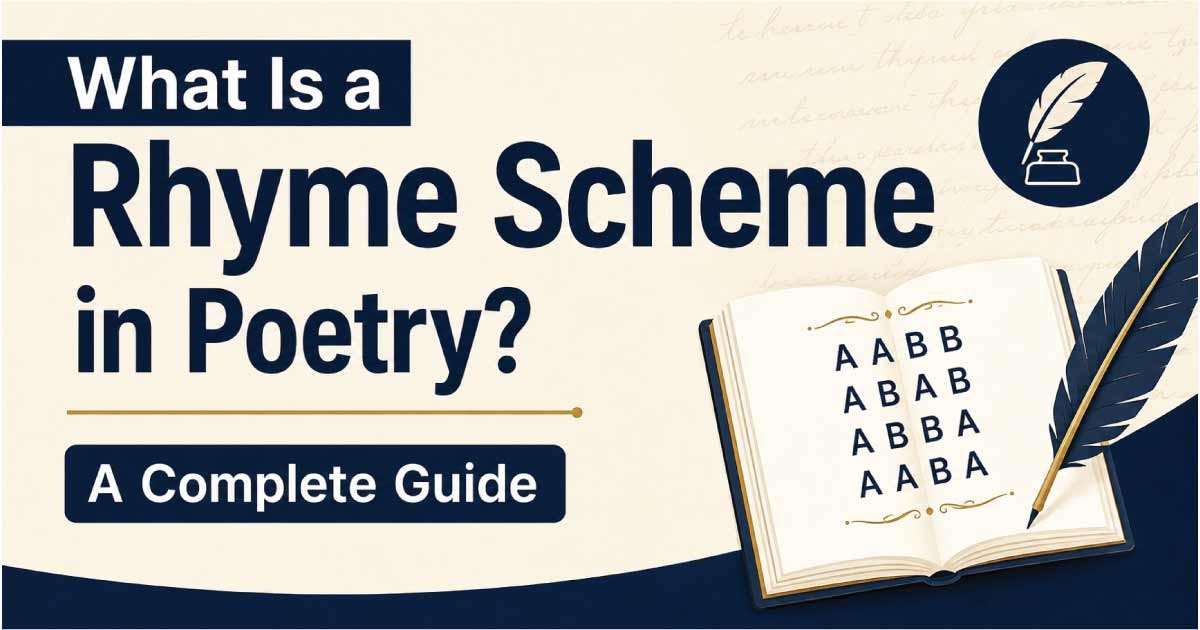
A rhyme scheme in poetry is the pattern of rhyming sounds at the ends of lines in a poem. Poets use letters such as A, B, C, and D to identify which lines rhyme with each other.
For example, if the first and third lines rhyme, they can both be labeled A. If the second and fourth lines rhyme with each other, they can both be labeled B. The resulting pattern is ABAB.
Rhyme schemes can give poems structure, rhythm, musicality, and memorability. They are especially common in traditional poetry, including sonnets, ballads, nursery rhymes, and songs.
However, not every poem has a rhyme scheme. Many modern poems and free verse poems do not use regular end rhyme.
Understanding what a rhyme scheme is in poetry helps readers analyze poems and helps writers choose structures that suit their ideas and emotions.
What Is a Rhyme Scheme in Poetry?
A rhyme scheme is the organized pattern of rhymes at the ends of lines in a poem.
Poets use letters to show the pattern.
For example:
The sun is shining bright — A
The birds begin to sing — B
The clouds have drifted out of sight — A
And flowers welcome spring — B
The pattern is:
ABAB
The first and third lines rhyme with each other, while the second and fourth lines rhyme with each other.
Simple Definition of Rhyme Scheme
A rhyme scheme is the pattern of end rhymes in a poem, represented by letters such as A, B, C, and D.
The pattern can be simple, such as AABB, or more complex, such as ABAB CDCD EFEF.
Why Is a Rhyme Scheme Important in Poetry?
A rhyme scheme can give a poem a recognizable structure.
Rhyme Schemes Can Help:
- Create musicality
- Establish rhythm
- Connect lines together
- Make poems easier to remember
- Emphasize important words
- Create expectations for readers
- Strengthen a poem’s structure
- Add emotional or dramatic effects
Rhyme is not required for good poetry, but when used intentionally, it can make a poem more memorable.
How Does a Rhyme Scheme Work?
To understand a rhyme scheme, focus on the sounds at the ends of lines, rather than simply looking at spelling.
Consider:
I watch the stars at night — A
They fill my heart with peace — B
Their silver glow is soft and bright — A
And brings my restless thoughts to ease — B
The rhyme pattern is:
ABAB
“Night” and “bright” rhyme, so they receive the same letter.
“Peace” and “ease” rhyme, so they receive another letter.
How to Identify a Rhyme Scheme
Finding a rhyme scheme is relatively simple once you know what to look for.
Step 1: Look at the First Line
Give the end sound of the first line the letter A.
Step 2: Examine the Second Line
If it does not rhyme with the first line, give it B.
Step 3: Compare the Third Line
If it rhymes with the first line, label it A.
If it introduces a new rhyme, label it C.
Step 4: Continue Through the Poem
Assign the same letter to lines that rhyme with one another.
For example:
The morning brings a golden light — A
The birds are singing in the tree — B
The clouds are fading from my sight — A
The world feels calm and wild and free — B
The rhyme scheme is:
ABAB
What Are the Most Common Rhyme Schemes?
Poets use many different rhyme schemes, but some patterns appear frequently.
AABB Rhyme Scheme
In an AABB pattern, the first two lines rhyme and the next two lines rhyme.
The moon is shining high — A
Across the evening sky — A
The quiet river flows below — B
While gentle evening breezes blow — B
Pattern:
AABB
This pattern is simple and easy to recognize.
ABAB Rhyme Scheme
In an ABAB pattern, alternate lines rhyme.
The flowers bloom in May — A
The birds return to sing — B
The winter fades away — A
And spring brings everything — B
Pattern:
ABAB
This is one of the most common patterns in English poetry.
ABCB Rhyme Scheme
In an ABCB pattern, only the second and fourth lines rhyme.
I walked beside the river — A
Beneath the evening sky — B
The water moved so gently — C
While clouds went drifting by — B
Pattern:
ABCB
This scheme is common in ballads and folk poetry.
AAAA Rhyme Scheme
In an AAAA pattern, every line ends with the same rhyme.
The stars are shining bright — A
The moon is full tonight — A
The world is wrapped in light — A
Everything feels right — A
Pattern:
AAAA
Using one rhyme repeatedly can create a strong musical effect, although it can become predictable if overused.
Common Rhyme Schemes at a Glance
| Rhyme Scheme | Pattern | General Effect |
|---|---|---|
| AABB | Couplets | Simple and musical |
| ABAB | Alternating | Balanced and flowing |
| ABCB | Second and fourth lines rhyme | Common in ballads |
| AAAA | All lines rhyme | Strong and repetitive |
| ABBA | Enclosed rhyme | Circular or balanced |
| ABCABC | Repeating three-line pattern | Structured and flowing |
The effect depends on how the poet uses the pattern and the subject of the poem.
What Is a Rhyming Couplet?
A rhyming couplet consists of two consecutive lines that rhyme.
For example:
The stars appear above the tree,
And night brings quiet thoughts to me.
The pattern is:
AA
Couplets can stand alone or appear within longer poems.
They are particularly useful for creating a sense of completion because the rhyme connects the two lines.
What Is an ABBA Rhyme Scheme?
The ABBA rhyme scheme is sometimes called an enclosed rhyme because the A rhymes surround the B rhymes.
For example:
The evening settles on the town — A
A gentle breeze moves through the trees — B
The distant river whispers with ease — B
While shadows slowly settle down — A
The pattern is:
ABBA
This structure can create a feeling of balance or enclosure.
ABBA is especially important in certain traditional poetic forms.
What Is the Rhyme Scheme of a Sonnet?
Different types of sonnets use different rhyme schemes.
English or Shakespearean Sonnet
A traditional Shakespearean sonnet typically has three quatrains followed by a couplet.
Its rhyme scheme is:
ABAB CDCD EFEF GG
The final couplet often provides a conclusion, contrast, question, or twist.
Petrarchan Sonnet
A traditional Petrarchan sonnet commonly begins with an octave using a pattern such as:
ABBAABBA
The sestet can have several different rhyme patterns, depending on the poem.
This demonstrates how rhyme schemes can be closely connected with poetic forms.
What Is the Rhyme Scheme of a Ballad?
Traditional English-language ballads often use an ABCB rhyme scheme.
A typical ballad stanza contains four lines, with the second and fourth lines rhyming.
For example:
The traveler walked beneath the moon — A
The road was cold and gray — B
He heard the distant sound of bells — C
Then slowly went his way — B
Pattern:
ABCB
Ballads often combine rhyme with a strong rhythm and storytelling structure.
What Is the Difference Between Rhyme and Rhyme Scheme?
These two terms are related but different.
Rhyme is the similarity between sounds.
Rhyme scheme is the overall pattern created by those rhymes throughout a poem.
For example, “light” and “night” rhyme.
If the first and third lines of a four-line poem end in “light” and “night,” while the second and fourth lines use another rhyme, the rhyme scheme may be ABAB.
| Rhyme | Rhyme Scheme |
|---|---|
| Similarity between sounds | Pattern of rhymes |
| Can occur between two words | Describes multiple lines |
| Example: light/night | Example: ABAB |
| A sound technique | A structural pattern |
What Is the Difference Between Rhyme Scheme and Meter?
Rhyme scheme and meter are two separate elements of poetry.
Rhyme scheme describes the pattern of rhyming sounds.
Meter describes the pattern of stressed and unstressed syllables.
A poem can have:
- Rhyme without regular meter
- Meter without rhyme
- Both rhyme and meter
- Neither regular rhyme nor meter
Rhyme Scheme vs. Meter
| Rhyme Scheme | Meter |
|---|---|
| Concerns end sounds | Concerns stress and syllable patterns |
| Uses letters such as A and B | Uses metrical feet |
| Creates connections between lines | Creates rhythmic structure |
| Can be regular or irregular | Can be regular or irregular |
Understanding both helps readers analyze formal poetry more effectively.
Discover More:
Do All Poems Have a Rhyme Scheme?
No.
Many poems do not use end rhyme at all.
Free verse often avoids fixed rhyme schemes and instead relies on:
- Natural speech
- Repetition
- Rhythm
- Imagery
- Line breaks
- Sound patterns
- Internal rhyme
Some modern poets use occasional rhyme without following a predictable pattern.
The absence of a regular rhyme scheme does not make a poem less meaningful or less poetic.
What Is Internal Rhyme?
Not all rhyme occurs at the ends of lines.
Internal rhyme occurs when rhyming words appear within the same line or across positions other than the line endings.
For example:
The light of the night filled the room.
“Light” and “night” rhyme within the line.
Internal rhyme can add musicality without creating a traditional end-rhyme scheme.
What Is Slant Rhyme?
Slant rhyme, also called near rhyme or imperfect rhyme, occurs when words have similar but not identical sounds.
For example:
- Shape / keep
- Soul / all
- Time / mine
The exact quality of the rhyme can vary depending on pronunciation and poetic tradition.
Slant rhyme gives poets more flexibility than perfect rhyme.
Discover More:
Perfect Rhyme vs. Slant Rhyme
| Perfect Rhyme | Slant Rhyme |
|---|---|
| Strong sound match | Partial sound match |
| More obvious | More subtle |
| Often highly musical | Can sound more natural |
| Common in traditional verse | Common in modern poetry |
Poets can choose between them depending on the desired effect.
How to Choose a Rhyme Scheme for Your Poem
If you are writing your own poem, begin by considering the purpose and mood.
Use AABB for Simplicity
AABB can work well for:
- Children’s poetry
- Lighthearted poems
- Short poems
- Simple storytelling
Use ABAB for Balance
ABAB provides a predictable but flexible structure.
It works well for:
- Love poems
- Nature poems
- Inspirational poetry
- Narrative poetry
Use ABCB for Storytelling
ABCB can work particularly well when you want the poem to feel like a ballad or folk song.
Use No Fixed Scheme for Flexibility
Free verse may be a better choice when you want natural speech and unrestricted line structure.
Discover More:
Tips for Writing With a Rhyme Scheme
Using rhyme effectively requires more than finding words that sound alike.
Do Not Force a Rhyme
Never choose an awkward word simply because it rhymes.
Meaning should remain more important than rhyme.
Avoid Predictable Rhymes
Very common rhyme pairs can sometimes make poetry feel repetitive.
Try using more specific images and less obvious word choices.
Consider the Meaning of the Rhyming Words
The words at the ends of lines naturally receive attention.
Use important words there when possible.
Read the Poem Aloud
Reading aloud helps you hear whether the rhyme sounds natural or forced.
Experiment
Try rewriting the same stanza with different patterns.
You may discover that one structure fits the poem much better than another.
How to Analyze a Rhyme Scheme
When analyzing a poem for school or literary study, follow a simple process.
Step 1: Number the Lines
Write down the lines in order.
Step 2: Examine the End Sounds
Focus on pronunciation rather than spelling.
Step 3: Assign Letters
Give the first rhyme the letter A.
Give a different rhyme the letter B.
Continue using the same letter whenever the same rhyme returns.
Step 4: Write the Pattern
For example:
ABAB CDCD EFEF GG
Step 5: Explain Its Effect
Do not stop after identifying the pattern.
Explain how the rhyme scheme contributes to:
- Rhythm
- Musicality
- Structure
- Emphasis
- Mood
- Memorability
That creates a stronger literary analysis.
Frequently Asked Questions About Rhyme Schemes
What is a rhyme scheme in poetry in simple words?
A rhyme scheme is the pattern of rhyming sounds at the ends of lines in a poem. Letters such as A, B, and C are used to represent the pattern.
What is an example of a rhyme scheme?
If the first and third lines rhyme and the second and fourth lines rhyme, the pattern is ABAB.
What does AABB mean in poetry?
AABB means the first two lines rhyme with each other, while the third and fourth lines rhyme with each other.
What does ABAB mean in poetry?
ABAB means the first and third lines rhyme, while the second and fourth lines rhyme.
What is the most common rhyme scheme?
There is no single rhyme scheme that is universally the most common. AABB, ABAB, and ABCB are among the frequently used patterns in English poetry.
Does every poem have a rhyme scheme?
No. Many poems, especially free verse, do not use a fixed rhyme scheme.
What is the rhyme scheme of a Shakespearean sonnet?
A traditional Shakespearean sonnet uses ABAB CDCD EFEF GG.
What is the rhyme scheme of a Petrarchan sonnet?
The octave of a traditional Petrarchan sonnet commonly follows ABBAABBA, while the sestet can use several different patterns.
What is the difference between rhyme and rhyme scheme?
Rhyme refers to the similarity between sounds, while a rhyme scheme describes the pattern those rhymes create throughout a poem.
Can a poem have more than one rhyme scheme?
Yes. A poem can change its rhyme scheme between stanzas or sections. Poets sometimes change patterns to reflect a change in subject, mood, or structure.
Conclusion: Understanding Rhyme Scheme in Poetry
A rhyme scheme in poetry is the organized pattern of rhyming sounds at the ends of lines. Writers and readers use letters such as A, B, C, and D to identify which lines rhyme.
Common patterns include AABB, ABAB, ABCB, AAAA, and ABBA. More complex forms, such as the Shakespearean sonnet, use patterns such as ABAB CDCD EFEF GG.
Rhyme scheme is different from both rhyme and meter. Rhyme describes similar sounds, rhyme scheme describes the pattern of those sounds, and meter describes the pattern of stressed and unstressed syllables.
Not every poem needs a fixed rhyme scheme. Modern and free verse poetry often uses other techniques to create musicality and structure.
Whether you are analyzing poetry or writing your own, understanding rhyme schemes gives you a better appreciation of how poets organize sound. When used thoughtfully, rhyme can make a poem more musical, memorable, structured, and emotionally powerful.