
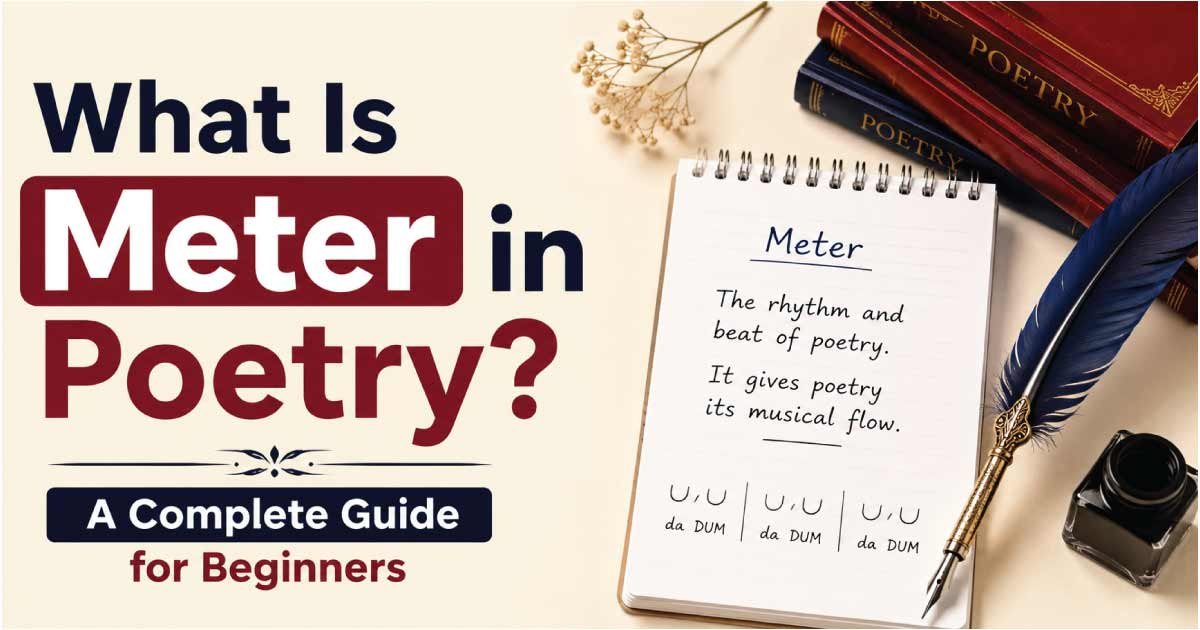
Meter in poetry is the regular pattern of stressed and unstressed syllables in a line of verse. It gives a poem a structured rhythm and can create a musical, flowing, dramatic, or memorable quality.
When you read poetry aloud, you may notice that certain syllables receive more emphasis than others. Poets can organize these stressed and unstressed syllables into repeated patterns. These patterns are called metrical feet, and the number of feet in a line helps determine its meter.
Meter is especially important in traditional poetry. Forms such as sonnets, ballads, and blank verse often use regular meters. One of the best-known examples is iambic pentameter, a meter associated with many works of English poetry.
Understanding what meter is in poetry can help you recognize poetic patterns, analyze poems, and improve your own writing.
What Is Meter in Poetry?
Meter is the organized pattern of stressed and unstressed syllables in a line of poetry.
In simple terms, meter is the measured beat or rhythmic pattern of a poem.
Poets use meter to give lines a consistent structure. A poem may have a steady pattern from beginning to end, or the poet may intentionally change the meter to create emphasis or reflect a change in emotion.
Simple Definition of Meter
Meter in poetry is a regular pattern of stressed and unstressed syllables that gives a line a rhythmic structure.
Meter is different from rhythm, although the two are closely connected.
Rhythm refers more broadly to the flow and movement of sounds, while meter refers to an organized or recurring rhythmic pattern.
Why Is Meter Important in Poetry?
Meter can make poetry easier to hear, remember, and perform.
A regular meter can create a musical quality, while variations in meter can draw attention to particular words or moments.
Meter Can Help Poets:
- Create rhythm
- Establish a musical pattern
- Control the pace of a poem
- Emphasize certain words
- Make lines memorable
- Support a traditional poetic form
- Create a particular mood
- Give a poem structural unity
Meter is not simply decoration. A poet can use it as an important part of the poem’s meaning and emotional effect.
How Does Meter Work?
Meter is built from stressed and unstressed syllables.
A stressed syllable receives more emphasis when spoken, while an unstressed syllable receives less emphasis.
For example, consider the word:
today
It is commonly pronounced approximately as:
to-DAY
The second syllable receives greater stress.
Poets can arrange stressed and unstressed syllables into recurring patterns.
These small patterns are called metrical feet.
What Is a Metrical Foot?
A metrical foot is a basic unit of poetic meter made from a particular arrangement of stressed and unstressed syllables.
The most common types of metrical feet in English poetry are:
| Metrical Foot | Pattern | Description |
|---|---|---|
| Iamb | ˘ / | Unstressed + stressed |
| Trochee | / ˘ | Stressed + unstressed |
| Anapest | ˘ ˘ / | Two unstressed + stressed |
| Dactyl | / ˘ ˘ | Stressed + two unstressed |
| Spondee | / / | Two stressed syllables |
Here:
- ˘ represents an unstressed syllable.
- / represents a stressed syllable.
A line of poetry can contain one or more of these feet.
What Is an Iamb?
An iamb contains two syllables:
unstressed + stressed
Its pattern is:
˘ /
A simple example is:
to-DAY
Another example is:
re-LAX
The stress falls on the second syllable.
Iambs are extremely common in English poetry because the unstressed-to-stressed pattern often resembles the natural rhythm of English speech.
What Is Iambic Meter?
When a poem repeatedly uses iambs, it has iambic meter.
For example:
˘ / | ˘ / | ˘ /
This contains three iambic feet and can be called iambic trimeter.
If a line contains five iambic feet, it is called iambic pentameter.
What Is Iambic Pentameter?
Iambic pentameter consists of five iambic feet:
˘ / | ˘ / | ˘ / | ˘ / | ˘ /
The word “pentameter” comes from the Greek-derived naming system in which “penta” refers to five.
Iambic pentameter is one of the most famous meters in English poetry. It is strongly associated with William Shakespeare and many other English poets.
What Is a Trochee?
A trochee reverses the order of an iamb.
Its pattern is:
stressed + unstressed
or:
/ ˘
For example:
TA-ble
The first syllable receives the greater stress.
When repeated, trochaic meter can produce a strong falling rhythm.
Trochaic Meter
A line containing four trochaic feet is called trochaic tetrameter.
Its basic pattern is:
/ ˘ | / ˘ | / ˘ | / ˘
Trochaic rhythms are sometimes especially noticeable in songs, children’s poetry, and poems with a strong, chant-like quality.
What Is an Anapest?
An anapest contains three syllables:
unstressed + unstressed + stressed
Its pattern is:
˘ ˘ /
The final syllable receives the stress.
Anapestic meter can create a rolling, lively, or forward-moving rhythm.
It can be useful for poems that need energy or a sense of motion.
Example of an Anapestic Pattern
A phrase such as:
in the NIGHT
can approximate the pattern:
˘ ˘ /
When this pattern is repeated across a line, it creates anapestic meter.
What Is a Dactyl?
A dactyl is the reverse of an anapest.
Its pattern is:
stressed + unstressed + unstressed
or:
/ ˘ ˘
A simple example is:
WON-der-ful
The first syllable is stressed more strongly.
Dactylic meter can create a distinctive falling rhythm and is found in various traditional poetic forms.
What Is a Spondee?
A spondee consists of two stressed syllables:
/ /
For example:
STOP NOW
Both words can receive strong emphasis.
Spondees are not usually used as the main meter of an entire English poem. Instead, poets may introduce spondaic substitutions into another meter to create emphasis or interrupt an expected rhythm.
What Are the Different Types of Meter?
Meter can be classified according to the type of metrical foot and the number of feet in each line.
Meter Based on Number of Feet
| Type of Meter | Number of Feet |
|---|---|
| Monometer | 1 |
| Dimeter | 2 |
| Trimeter | 3 |
| Tetrameter | 4 |
| Pentameter | 5 |
| Hexameter | 6 |
| Heptameter | 7 |
| Octameter | 8 |
For example:
Iambic pentameter = five iambs per line.
Trochaic tetrameter = four trochees per line.
Anapestic trimeter = three anapests per line.
This naming system allows readers and scholars to describe the meter of a poem precisely.
What Is the Difference Between Meter and Rhythm?
Meter and rhythm are closely related but should not be treated as identical.
Rhythm is the overall flow and movement of sound in language.
Meter is a recurring, organized pattern of stresses and syllables.
Think of rhythm as the broader musical movement and meter as a particular beat pattern imposed on that movement.
| Meter | Rhythm |
|---|---|
| Regular or recurring pattern | Overall flow of sound |
| More structured | Can be highly flexible |
| Based heavily on stress patterns | Created through stress, pauses, word choice, repetition, and line structure |
| Common in formal poetry | Found in both formal and free verse |
| Can be analyzed using metrical feet | Can be analyzed more broadly |
A poem can have rhythm without having a regular meter.
Does Every Poem Have Meter?
No. Not every poem follows a regular meter.
Traditional poetry often uses meter, but free verse generally does not follow a fixed metrical pattern.
Free verse may still have strong rhythm through:
- Natural speech
- Repetition
- Line breaks
- Pauses
- Word choice
- Sentence length
- Sound patterns
For example:
I wait
beside the window,
watching the rain
disappear into the dark.
This poem may have rhythm, but it does not need to follow a regular metrical pattern.
Discover More:
What Is Iambic Pentameter Used For?
Iambic pentameter is particularly important in English literary history.
It has been used in:
- Sonnets
- Plays
- Narrative poetry
- Dramatic monologues
- Blank verse
- Formal verse
Its rhythm often sounds relatively natural in English, which makes it flexible enough for dialogue and serious poetic expression.
Shakespeare frequently used iambic pentameter in his dramatic works, making the meter one of the most recognizable patterns in English literature.
What Is Blank Verse?
Blank verse is poetry written in a regular meter—traditionally iambic pentameter—but without end rhyme.
This distinction is important because people sometimes assume that formal poetry must rhyme.
Blank verse demonstrates that a poem can have a highly structured meter without using a regular rhyme scheme.
It has been widely used in English drama and narrative poetry.
How Does Meter Affect the Sound of a Poem?
Meter influences how a poem moves when spoken aloud.
Regular Meter
A consistent meter can make a poem feel:
- Musical
- Orderly
- Balanced
- Predictable
- Memorable
Irregular Meter
Breaking the expected pattern can make a word or phrase stand out.
For example, if most of a poem follows a regular rhythm and one line suddenly changes, the change may signal:
- Strong emotion
- Conflict
- Surprise
- Important information
- A change in tone
This is why skilled poets do not always follow meter mechanically. Variation can be just as meaningful as regularity.
Discover More:
How to Identify Meter in a Poem
Identifying meter can seem difficult at first, but it becomes easier with practice.
Step 1: Read the Poem Aloud
Start by listening to the natural stresses in the line.
Step 2: Mark Stressed Syllables
Mark syllables that receive strong emphasis with a slash:
/
Mark unstressed syllables with:
˘
Step 3: Look for a Repeating Pattern
Check whether the syllables form a recognizable pattern such as:
˘ / = iamb
or:
/ ˘ = trochee
Step 4: Count the Feet
Count how many times the pattern occurs.
For example:
˘ / | ˘ / | ˘ / | ˘ / | ˘ /
contains five iambs.
Therefore, the line is written in iambic pentameter.
Step 5: Look for Variations
Do not assume every line will be perfectly regular. Poets often alter meter for emphasis or natural speech.
Discover More:
How Can Meter Improve Your Poetry?
Learning about meter can give you greater control over your writing.
You do not necessarily need to write every poem in a strict meter. Understanding meter simply gives you another tool.
Practice With a Simple Pattern
Start by writing short lines using iambs:
˘ / | ˘ / | ˘ /
Then experiment with four or five feet.
Read Your Poem Aloud
Your ear is an important tool.
If a line feels awkward, try changing the word order or replacing a word with one that fits the rhythm better.
Do Not Sacrifice Meaning for Meter
A common mistake among beginners is forcing words into a metrical pattern.
Good poetry should sound natural. If a word feels unnatural simply because it fits the meter, consider changing the line.
Use Variations Intentionally
Once you understand a regular pattern, you can deliberately break it.
A change in meter can make an important word more noticeable.
Meter in Different Types of Poetry
Meter appears more frequently in some poetic forms than others.
| Poetry Type | Use of Meter |
|---|---|
| Sonnet | Often highly structured |
| Blank verse | Usually regular meter without end rhyme |
| Ballad | Often uses regular rhythmic patterns |
| Epic poetry | Traditional examples often use formal meter |
| Free verse | Usually no fixed meter |
| Spoken-word poetry | Often uses flexible, speech-based rhythm |
| Children’s poetry | Frequently uses strong rhythmic patterns |
| Nursery rhymes | Often use noticeable rhythmic patterns |
Modern poets have considerable freedom to combine or abandon traditional meters.
Why Is Meter Important to Poetry Students?
Understanding meter helps students move beyond simply identifying what a poem says.
When studying meter, you can explore how the poem says it.
Meter can reveal:
- The poem’s form
- Its historical style
- Its musical quality
- Changes in emphasis
- Variations in tone
- The poet’s technical choices
For students studying formal poetry, recognizing meter is an important part of literary analysis.
Frequently Asked Questions About Meter in Poetry
What is meter in poetry in simple words?
Meter is a regular pattern of stressed and unstressed syllables in a line of poetry. It creates a structured rhythmic pattern.
What is the difference between meter and rhythm?
Rhythm is the overall flow of sound in language, while meter is a regular and organized pattern of stressed and unstressed syllables.
What is a metrical foot?
A metrical foot is a small unit of stressed and unstressed syllables that forms part of a poetic meter.
What are the main types of metrical feet?
The most common types are iamb, trochee, anapest, dactyl, and spondee.
What is iambic pentameter?
Iambic pentameter is a meter consisting of five iambic feet in each line. Its basic pattern is unstressed-stressed repeated five times.
Does every poem have meter?
No. Many poems, especially free verse poems, do not use a fixed meter. They can still have rhythm.
Is meter the same as rhyme?
No. Meter concerns the pattern of stressed and unstressed syllables, while rhyme concerns similarities between sounds.
How do I find the meter of a poem?
Read the poem aloud, mark stressed and unstressed syllables, identify repeating patterns, and count the number of metrical feet in each line.
Why do poets use meter?
Poets use meter to create rhythm, musicality, structure, emphasis, and a memorable reading experience.
Conclusion: Understanding What Meter Is in Poetry
Meter in poetry is the organized pattern of stressed and unstressed syllables that gives a poem a regular rhythmic structure. It is created through metrical feet such as iambs, trochees, anapests, dactyls, and spondees.
Meter can be described according to the number of feet in a line. For example, iambic pentameter contains five iambic feet, while trochaic tetrameter contains four trochaic feet.
Meter is closely connected to rhythm, but the terms have different meanings. Rhythm describes the broader movement of sound, while meter describes a recurring rhythmic pattern.
Not every poem uses regular meter. Free verse often relies on natural speech, repetition, pauses, and line breaks instead. Even in formal poetry, skilled poets may deliberately vary the meter to create emphasis or emotional effects.
The best way to understand poetic meter is to read poems aloud and listen carefully to their stresses and patterns. With practice, you will begin to recognize the beat beneath the words and understand how poets use meter to make their writing more musical, memorable, and expressive.