
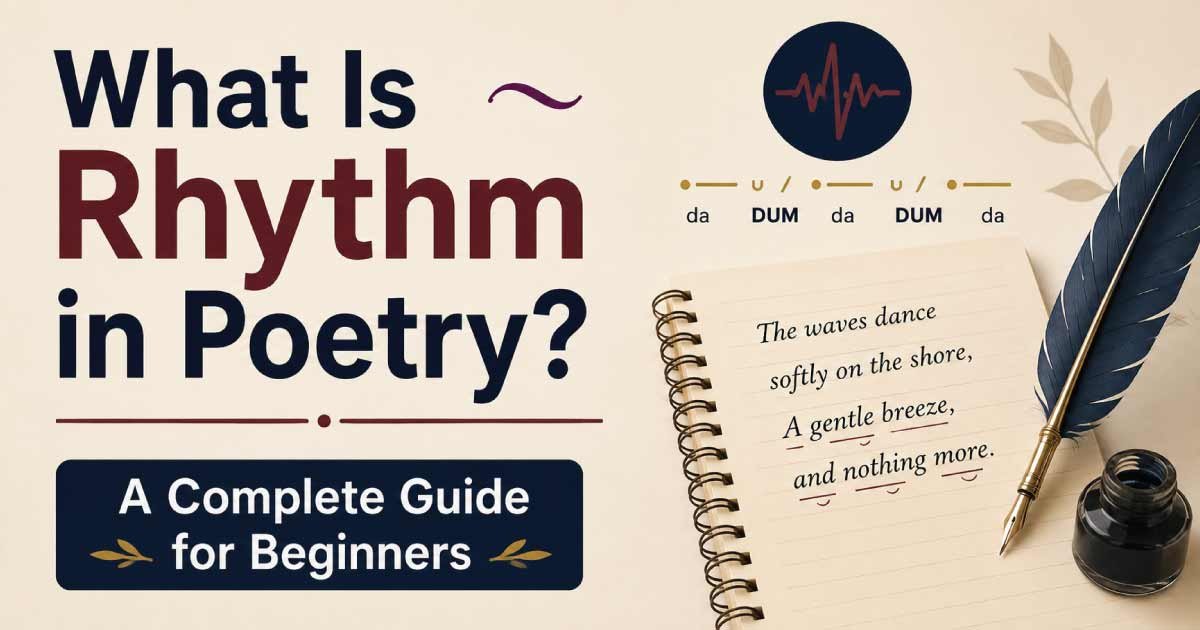
Rhythm in poetry is the pattern of stressed and unstressed sounds that creates movement, pace, and musical quality in a poem. It is one of the elements that makes poetry sound different from ordinary prose.
When you read a poem aloud, you may notice that some syllables naturally receive more emphasis than others. The arrangement of these stressed and unstressed syllables creates a rhythm. Sometimes the rhythm is regular and predictable; other times, poets deliberately vary it to create surprise, emotion, or emphasis.
Rhythm can make a poem sound peaceful, energetic, dramatic, playful, serious, or even tense. It can also affect how quickly or slowly a reader moves through the words.
Understanding what rhythm is in poetry can help you read poems more confidently and write your own poetry with greater control. It is closely related to meter, but rhythm and meter are not exactly the same thing.
What Is Rhythm in Poetry?
Rhythm in poetry is the pattern or flow of sounds created by stressed and unstressed syllables, pauses, word choices, and line structure.
In simple terms, rhythm is the beat or musical movement of a poem.
Think about how people naturally speak. We do not pronounce every syllable with exactly the same amount of emphasis. Some words or syllables receive greater stress, while others are spoken more lightly.
Poets can use these natural patterns to create a deliberate sound and movement.
Simple Definition of Rhythm
A simple definition is:
Rhythm in poetry is the pattern of stressed and unstressed syllables that creates a poem’s flow, pace, and musical quality.
Rhythm can occur in both rhyming and non-rhyming poetry. A poem does not need to rhyme to have rhythm.
Why Is Rhythm Important in Poetry?
Rhythm gives poetry movement. Without rhythm, a poem may sound like ordinary speech, although some forms of modern poetry intentionally use conversational rhythms.
A poet can use rhythm to influence the reader’s emotional response.
Rhythm Can Help a Poem:
- Create a musical quality
- Control reading speed
- Establish mood
- Emphasize certain words
- Make lines memorable
- Support storytelling
- Create tension
- Produce a feeling of calm
- Make a poem easier to perform aloud
For example, a poem describing a peaceful evening might use slow, flowing rhythms, while a poem describing a chase might use shorter, faster rhythms.
How Does Rhythm Work in Poetry?
Rhythm develops through several features of language.
Stressed and Unstressed Syllables
A stressed syllable receives more emphasis when spoken.
An unstressed syllable receives less emphasis.
Consider the word “today.”
When spoken naturally, the second syllable often receives greater emphasis:
to-DAY
The contrast between weaker and stronger syllables contributes to the rhythm of speech.
Poets can arrange these patterns intentionally across lines.
Word Choice
The words a poet chooses can influence rhythm.
Short words may create a quick, direct feeling:
Run, jump, turn, go.
Longer words and phrases may slow the movement:
Slowly the evening settles over the quiet fields.
The second example naturally takes longer to say and creates a gentler rhythm.
Punctuation and Pauses
Punctuation can also affect poetic rhythm.
Commas, dashes, periods, and line breaks can tell readers where to pause or change their pace.
For example:
Wait—
listen—
the night is breathing.
The pauses create a slower, more dramatic rhythm.
What Is Meter in Poetry?
Meter is the regular, organized pattern of stressed and unstressed syllables in poetry.
This distinction is important:
- Rhythm is the broader flow and movement of language.
- Meter is a more regular and structured rhythmic pattern.
You can think of rhythm as the overall beat of a poem, while meter is a particular system used to organize that beat.
Rhythm vs. Meter
| Rhythm | Meter |
|---|---|
| General flow of sound | Regular rhythmic pattern |
| Can be flexible | Usually follows a defined pattern |
| Found in poetry and ordinary speech | Especially associated with formal poetry |
| Can change throughout a poem | Often remains consistent |
| Created by many features | Primarily based on patterns of stress |
Every poem can have rhythm, but not every poem follows a regular meter.
What Is a Metrical Foot?
A metrical foot is a small unit of stressed and unstressed syllables used to describe poetic meter.
Different combinations create different types of poetic feet.
The most common include:
| Metrical Foot | Pattern |
|---|---|
| Iamb | unstressed – stressed |
| Trochee | stressed – unstressed |
| Anapest | unstressed – unstressed – stressed |
| Dactyl | stressed – unstressed – unstressed |
| Spondee | stressed – stressed |
These patterns are often represented using symbols:
- ˘ = unstressed syllable
- / = stressed syllable
For example, an iamb can be shown as:
˘ /
An anapest can be shown as:
˘ ˘ /
What Is Iambic Rhythm?
An iamb consists of an unstressed syllable followed by a stressed syllable.
The basic pattern is:
˘ /
One common example is:
to-DAY
The stress falls on the second syllable.
When iambs are repeated across a line, they create iambic meter.
Iambic Pentameter
Iambic pentameter contains five iambic feet in a line.
The basic pattern is:
˘ / | ˘ / | ˘ / | ˘ / | ˘ /
Iambic pentameter is one of the most famous meters in English poetry and is strongly associated with Shakespeare and other major poets.
What Is Trochaic Rhythm?
A trochee reverses the pattern of an iamb.
Its structure is:
/ ˘
That means a stressed syllable is followed by an unstressed syllable.
For example:
TA-ble
The first syllable receives more emphasis.
Trochaic rhythm can create a strong, falling beat and is frequently found in songs, children’s poetry, and certain formal poetic works.
What Is Anapestic Rhythm?
An anapest contains two unstressed syllables followed by one stressed syllable.
Its pattern is:
˘ ˘ /
Anapestic rhythm can create a rolling or energetic movement.
It is often effective for poems that need a lively, bouncing, or forward-moving sound.
What Is Dactylic Rhythm?
A dactyl contains one stressed syllable followed by two unstressed syllables.
Its pattern is:
/ ˘ ˘
Dactylic rhythm can produce a distinctive falling movement.
It appears in various traditional poetic forms and can contribute to a grand or flowing sound.
What Is Spondaic Rhythm?
A spondee consists of two stressed syllables:
/ /
Spondees are less commonly used as the basic meter of an entire English poem. Instead, poets may use them within a line to create emphasis.
For example, a phrase such as:
STOP NOW
contains two strongly emphasized words.
A poet can use this kind of stress to interrupt an otherwise regular rhythm.
What Are the Main Types of Poetic Meter?
The names of common meters are based partly on the number of metrical feet in a line.
| Meter | Number of Feet |
|---|---|
| Monometer | 1 |
| Dimeter | 2 |
| Trimeter | 3 |
| Tetrameter | 4 |
| Pentameter | 5 |
| Hexameter | 6 |
| Heptameter | 7 |
| Octameter | 8 |
For example, iambic pentameter means a line containing five iambic feet.
Similarly, trochaic tetrameter means a line containing four trochaic feet.
Discover More:
How Does Rhythm Affect the Mood of a Poem?
Rhythm can strongly influence mood.
Slow Rhythm
Longer phrases, softer sounds, and pauses can create a peaceful or reflective feeling.
This can work well for:
- Nature poetry
- Meditation
- Memories
- Grief
- Quiet reflection
Fast Rhythm
Short phrases, repeated sounds, and strong stresses can create energy and urgency.
This may work well for:
- Action
- Excitement
- Fear
- Conflict
- Celebration
Changing Rhythm
A poet can deliberately change rhythm to show an emotional or dramatic shift.
For example, a poem might begin with slow lines describing loneliness and then suddenly use short, forceful lines when the speaker becomes angry or determined.
Discover More:
What Is the Difference Between Rhythm and Rhyme?
Rhythm and rhyme are sometimes confused, but they are different poetic techniques.
Rhythm concerns the flow and pattern of sounds and stresses.
Rhyme concerns similarities between sounds, often at the ends of lines.
For example:
The moon is shining bright,
Across the quiet night.
“Bright” and “night” rhyme.
The pattern of stresses and syllables throughout the lines contributes to rhythm.
Rhythm vs. Rhyme
| Rhythm | Rhyme |
|---|---|
| Pattern of sound and stress | Similarity between sounds |
| Creates flow and movement | Creates sound connections |
| Can exist without rhyme | Does not create the overall rhythm by itself |
| Found in all kinds of poetry | Optional in poetry |
A poem can have rhythm without rhyme, and it can also use rhyme while having a relatively conversational rhythm.
Can Free Verse Have Rhythm?
Yes. Free verse can have rhythm even when it does not have regular meter or rhyme.
Free verse often relies on:
- Natural speech patterns
- Repetition
- Line length
- Pauses
- Punctuation
- Sound patterns
- Word choice
- Repeated phrases
For example:
I walk slowly
through the empty street,
listening
to the sound of rain.
The poem does not need a fixed meter to have a noticeable flow.
Free verse gives poets freedom to create rhythm without following traditional metrical rules.
Discover More:
How Can You Identify Rhythm in a Poem?
Finding rhythm becomes easier when you read the poem aloud.
Step 1: Read the Poem Naturally
Do not immediately try to mark every syllable. First listen to how the poem sounds.
Step 2: Notice Stressed Words
Pay attention to the syllables or words that naturally receive emphasis.
Step 3: Look for Repeated Patterns
Ask whether stressed and unstressed syllables appear in a regular pattern.
Step 4: Notice Pauses
Look at punctuation and line breaks.
Step 5: Read It Again
Poetry often sounds different when read multiple times. Listen for changes in speed, emphasis, and mood.
How to Improve Rhythm When Writing Poetry
Good rhythm does not always happen automatically. You can improve it by reading your poem aloud and experimenting with different word choices.
Read Your Poem Aloud
This is one of the simplest and most useful techniques.
If a line feels difficult to say, it may need revision.
Remove Unnecessary Words
Extra words can make a line slow or awkward.
Choose words that communicate your meaning efficiently.
Experiment With Line Length
Short lines can create pauses and emphasis.
Longer lines can create a flowing or conversational effect.
Use Repetition
Repeating a word or phrase can establish a recognizable rhythm.
For example:
I remember the rain.
I remember the road.
I remember the morning.
The repeated phrase creates a rhythmic pattern.
Do Not Force a Meter
If you are writing free verse, you do not need to make every line fit a strict pattern.
The rhythm should support the meaning rather than make the poem sound unnatural.
Why Should Poets Study Rhythm?
Understanding rhythm gives poets greater control over their writing.
When you recognize how rhythm works, you can deliberately choose a style that suits your subject.
For example:
- A calm poem may benefit from flowing rhythms.
- A humorous poem may use a bouncy rhythm.
- A dramatic poem may use changing rhythms.
- A spoken-word poem may follow natural speech.
- A traditional poem may use regular meter.
Rhythm is therefore not simply a technical feature. It is part of how a poem communicates emotion and meaning.
Frequently Asked Questions About Rhythm in Poetry
What is rhythm in poetry in simple words?
Rhythm is the pattern and flow of stressed and unstressed sounds in a poem. It creates movement, pace, and musical quality.
Is rhythm the same as meter?
No. Rhythm is the broader flow of sound, while meter is a regular, organized pattern of stressed and unstressed syllables.
Does every poem have rhythm?
Most poetry has some form of rhythm, although the rhythm may be irregular or conversational. Free verse, for example, can have rhythm without a fixed meter.
Does rhythm mean rhyme?
No. Rhythm concerns the flow and stress of sounds, while rhyme involves similarities between sounds, often at the ends of lines.
What is an iamb in poetry?
An iamb is a metrical foot consisting of an unstressed syllable followed by a stressed syllable: ˘ /.
What is iambic pentameter?
Iambic pentameter is a poetic meter containing five iambic feet in a line. Its basic pattern is five repetitions of unstressed followed by stressed syllables.
How can I find rhythm in a poem?
Read the poem aloud and listen for stressed syllables, pauses, repeated sounds, line breaks, and patterns of movement. Marking stressed and unstressed syllables can help with formal meter.
Why is rhythm important in poetry?
Rhythm gives a poem movement and can influence its mood, pace, musicality, emphasis, and emotional impact.
Conclusion: Understanding Rhythm in Poetry
Rhythm in poetry is the pattern and flow of sounds created through stressed and unstressed syllables, word choice, pauses, repetition, and line structure. It gives poetry movement and can make words feel musical, dramatic, peaceful, energetic, or emotional.
Rhythm is closely connected with meter, but the two terms are not identical. Meter refers to a regular rhythmic pattern, while rhythm is the broader flow of language.
Traditional poetry may use patterns such as iambic, trochaic, anapestic, and dactylic meter. Modern free verse may use irregular rhythms based on natural speech, repetition, punctuation, and line breaks.
The easiest way to understand rhythm is to read poetry aloud. Listen to where your voice naturally becomes stronger, where you pause, and how quickly or slowly the words move.
Once you understand rhythm, you can better appreciate why certain poems sound memorable—and you can use the same techniques to make your own poetry more expressive, musical, and powerful.