
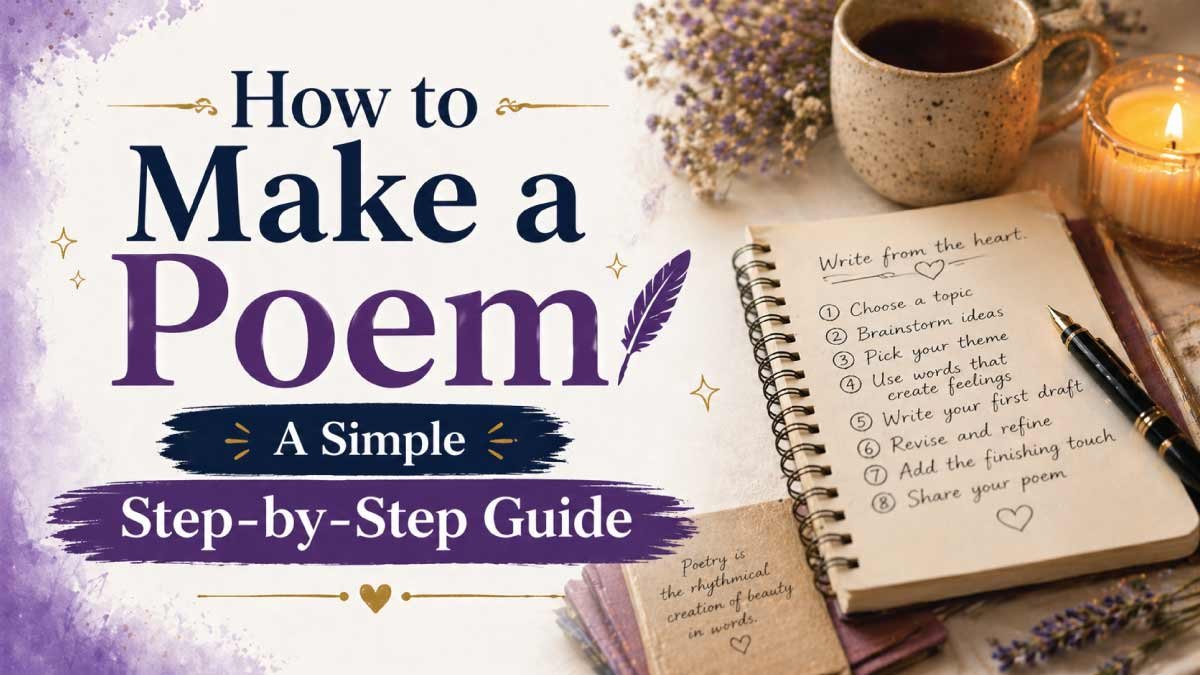
Writing a poem may seem difficult at first, especially if you think it requires perfect rhymes or advanced vocabulary. But the truth is, making a poem is about expressing your thoughts and emotions in a creative way.
You do not need to be a professional writer to create a meaningful poem. With the right steps and a little practice, anyone can learn how to make a poem that feels real and powerful.
In this complete guide, you will learn exactly how to make a poem from scratch, even if you are a beginner.
What Does It Mean to Make a Poem?
To make a poem means to express your thoughts, feelings, or ideas in a creative and artistic way using carefully chosen words. Instead of simply explaining something, poetry turns emotions into a beautiful form where meaning, rhythm, and imagination come together to create something deeper and more expressive than normal writing.
In poetry, the focus is not only on what you say but also on how you say it. Even simple ideas can feel powerful when written in a poetic style. It allows a writer to share personal emotions in a way that connects with readers on a deeper level.
- Emotions
- Word choice
- Rhythm and flow
- Imagination
A poem does not need to follow strict grammar rules or structures. What matters most is honesty and meaning. If your words carry feeling and connect with the reader, it can be considered a poem, no matter how simple it is.
Step-by-Step Process: How to Make a Poem
Writing a poem becomes much easier when you follow a simple step-by-step process. Instead of trying to write everything perfectly at once, you slowly build your poem by focusing on ideas, emotions, and expression. Each step helps you turn your thoughts into meaningful and creative writing.
1. Start with an Idea or Feeling
Every poem begins with something inside you that you want to express. It can be a strong emotion, a memory, or even a small moment that left an impact. When your starting point is clear, it becomes easier to shape your poem around that feeling and give it direction.
- What am I feeling right now?
- What experience do I want to share?
- What message do I want to give?
Your idea can come from love, sadness, nature, motivation, or personal memories. The more genuine the feeling, the more powerful your poem will become.
2. Choose a Style (Optional)
Before you start writing, you can decide what kind of poem you want to create. This step is optional because poetry does not always need strict structure, but choosing a style can help guide your writing.
- Free verse (no rules)
- Rhyming poem
- Short poem
- Story-based poem
If you are a beginner, free verse is the easiest choice because it allows you to write freely without worrying about rhyme or structure.
3. Write Your First Lines Freely
Now begin writing your first draft without stopping or overthinking. At this stage, focus only on expressing your thoughts. Don’t worry about perfection, grammar, or structure. Just let your emotions flow naturally onto the page.
- Don’t worry about grammar
- Don’t try to be perfect
- Just let your thoughts flow
Example:
I walked alone under a silent sky
thinking about things I never said
This is your raw material, which you will improve later.
4. Use Imagery to Make It Powerful
Imagery means creating pictures in the reader’s mind using words. Instead of simply stating feelings, you describe them in a way that helps the reader imagine and feel them more deeply. This makes your poem more engaging and emotional.
Instead of writing:
“I was tired”
Write:
“My steps felt heavy like stones on a broken road”
Strong imagery makes poetry more expressive and memorable.
5. Add Emotion and Depth
Poetry is not just about writing lines—it is about sharing real emotions. Every line should carry meaning that the reader can feel. When your words are honest and emotional, your poem becomes more powerful and relatable.
- Does this line show emotion?
- Can the reader feel something?
Always focus on sincerity rather than complicated words.
6. Decide If You Want Rhyme
Rhyme is not necessary in poetry, but it can add rhythm and musical flow. You can choose whether to use it based on your style and comfort.
Use rhyme if:
- You want a musical sound
- You enjoy structured writing
Avoid rhyme if:
- It feels forced
- It limits your expression
Example with rhyme:
I see the light in darkest night
It gives me hope, it feels so right
Example without rhyme:
The night was quiet
but my thoughts were louder than ever
Both styles are valid and equally meaningful.
7. Break Your Lines Properly
Line breaks help control the rhythm and flow of your poem. Instead of writing long sentences like paragraphs, breaking lines creates a better reading experience and emotional effect.
Example:
The wind moved softly
through empty streets
carrying whispers
of forgotten dreams
Good line breaks make your poem feel more artistic and structured.
8. Read Your Poem Out Loud
Reading your poem aloud helps you understand how it sounds. You can easily notice if any line feels awkward, too long, or unclear. This step improves the natural flow of your writing.
It helps you:
- Check rhythm
- Find awkward lines
- Improve flow
If something doesn’t sound right, adjust it.
9. Edit and Improve
Your first draft is never your final poem. Editing is where your poem becomes stronger and more refined. This step helps you polish your writing and remove unnecessary parts.
- Remove unnecessary words
- Replace weak words with stronger ones
- Improve clarity and emotion
Editing is what turns simple writing into meaningful poetry.
10. Give It a Meaningful Ending
The ending of your poem is very important because it leaves a lasting impression on the reader. A strong final line can make your poem unforgettable and emotionally powerful.
- Add a deep thought
- Create a twist
- End with emotion
A good ending gives your poem its final impact and meaning.
Also Read:
Simple Example of a Finished Poem
A finished poem does not always need complex words or rhyming lines. Even a short and simple poem can feel complete if it carries emotion and meaning. The key is how well it expresses a feeling or moment in a clear and natural way that the reader can connect with.
Here is a simple example of a finished poem that shows emotion without using rhyme:
- The sun disappeared behind the hills
- leaving shadows in my mind
- I searched for answers in the dark
- but only silence replied
This poem is effective because it creates a strong visual image and emotional depth in just a few lines. It describes a feeling of loneliness and searching for answers, which many readers can relate to in their own way. This poem does not rhyme but still feels complete and emotional.
Common Techniques to Improve Your Poem
Using poetic techniques helps you turn simple writing into expressive and creative poetry. These devices add depth, emotion, and imagery to your work, making it more interesting and meaningful for readers. Learning and applying them can greatly improve the overall quality of your poems.
1. Simile
A simile is a poetic device that compares two different things using “like” or “as.” It helps create clear mental images for the reader. By linking familiar ideas with emotions or objects, similes make your descriptions more vivid, relatable, and easier to understand in poetry.
2. Metaphor
A metaphor is a direct comparison where one thing is described as another without using “like” or “as.” It adds deeper meaning and emotional strength to poetry. Metaphors help express complex thoughts in a simple, powerful way, making your writing more impactful and imaginative.
3. Personification
Personification gives human qualities to non-living things, animals, or ideas. It makes your poetry more lively and expressive by allowing readers to emotionally connect with objects or nature. This technique brings imagination into your writing and makes scenes feel more alive and engaging.
4. Repetition
Repetition is the use of the same words or phrases more than once to emphasize meaning. It helps highlight emotions, create rhythm, and make key ideas more memorable. When used properly, repetition strengthens the message of your poem and improves its emotional impact.
Also Read:
Common Mistakes to Avoid
Understanding common mistakes in poetry can help you improve faster and write more effectively. Many beginners repeat similar errors that reduce the quality of their poems. Avoiding these issues allows your writing to become clearer, more emotional, and more professional over time.
1. Forcing Rhyme
Forcing rhyme can make your poem sound unnatural and awkward. Instead of focusing only on matching words, prioritize meaning and flow. Natural expression is more important than forced rhyming because it keeps your poem smooth, readable, and emotionally strong.
2. Using Too Many Words
Overusing words can weaken the impact of your poem and confuse the reader. Simple and clear language is more powerful in poetry. Every word should have a purpose, helping to express emotion or build meaning without unnecessary complexity or repetition.
3. Lack of Emotion
A poem without emotion feels empty and uninteresting. Poetry is meant to express feelings, thoughts, and experiences. When you write with genuine emotion, your words become more powerful and relatable, allowing readers to connect deeply with your message.
4. Copying Others
Copying other poets may limit your creativity and originality. While learning from others is helpful, your poetry should reflect your own voice and experiences. Original writing makes your work unique, meaningful, and more enjoyable for readers who value authenticity.
5. Skipping Editing
Skipping editing can leave mistakes and weak lines in your poem. Revising your work helps improve structure, flow, and clarity. Editing allows you to refine your ideas and make your poem more polished, effective, and emotionally strong.
Tips to Make Better Poems
Improving poetry requires consistent practice and creative exploration. By following simple habits and techniques, you can gradually enhance your writing skills, develop your unique style, and produce more meaningful and expressive poems over time.
1. Write Regularly
Writing regularly helps you build confidence and improve your poetic skills. The more you practice, the better your ideas and expressions become. Consistency allows you to develop your style and naturally express emotions through words.
2. Read Other Poems
Reading different types of poetry exposes you to new styles, ideas, and techniques. It helps you understand how other writers express emotions and structure their work, which can inspire and improve your own writing abilities.
3. Observe Your Surroundings
Inspiration often comes from everyday life. Paying attention to people, nature, and small moments can help you find unique ideas for poetry. Observation strengthens creativity and allows you to write more meaningful and relatable poems.
4. Keep Notes
Keeping notes helps you capture ideas whenever they come to mind. Even small thoughts can turn into powerful poems later. Writing down ideas ensures you never lose inspiration and always have material to work on.
5. Experiment Freely
Experimenting with different styles and forms helps you discover your strengths as a poet. Trying new approaches without fear encourages creativity and growth. Freedom in writing allows you to develop a unique and personal poetic voice.
Also Read:
How Long Should a Poem Be?
There is no fixed rule for how long a poem should be. Poetry does not depend on length; it depends on expression. Some poems are only a few lines long, while others are very detailed and extended. What matters most is how effectively the poem communicates emotion and meaning.
- Short poems can be powerful
- Long poems can tell deeper stories
The best approach is to focus on quality, clarity, and emotional impact rather than counting lines or words. A strong idea written simply can be more meaningful than a long but unclear poem.
Can Anyone Learn How to Make a Poem?
Yes, anyone can learn how to make a poem. Poetry is not limited to special writers or naturally gifted people. It is a creative skill that develops over time with effort and practice. The more you write, the better you understand how to express your thoughts in a meaningful way.
- Practice
- Patience
- Creativity
Even beginners can write beautiful and emotional poems by starting small and staying consistent. The key is to write honestly and not worry about being perfect.
Why Making Poems Is Important
Writing poems is more than just a creative activity, it also has emotional and mental benefits. It helps people express feelings that are difficult to say in normal conversation. Poetry can also improve thinking, imagination, and communication skills.
- Helps express emotions
- Reduces stress
- Improves creativity
- Builds confidence
- Enhances writing skills
Poetry is not just about writing words on paper. It is a powerful way to understand your emotions, reflect on your thoughts, and connect more deeply with yourself and others.
Final Thoughts
Making a poem is not as difficult as many people assume. You don’t need perfect grammar, advanced vocabulary, or strict rules to start writing. What truly matters in poetry is honesty and the ability to express your thoughts and emotions in a natural and meaningful way that feels real.
Start with a simple idea, such as a feeling, memory, or observation, and let your words flow freely. Don’t worry about making it perfect in the first draft. With regular practice, you will gradually improve your writing style, develop confidence, and discover your own unique poetic voice.
Conclusion
If you’ve been wondering how to make a poem, the simplest answer is to just start writing without overthinking. Many beginners stop themselves by focusing too much on mistakes or structure, but poetry is meant to be a free and creative form of expression.
Remember, poetry is about expression, not perfection. It is a way to share emotions, thoughts, and experiences in your own unique style.
By following the steps in this guide, practicing regularly, and exploring your creativity, you will slowly build skill and confidence. Over time, you will be able to write poems that not only express your feelings but also deeply connect with your readers.
FAQs:
What does it mean to make a poem?
Making a poem means expressing thoughts, feelings, or ideas in a creative and artistic way. Instead of plain writing, poetry uses rhythm, imagery, and emotion. It focuses on how words feel and sound, not just their meaning. Even simple words can become a poem if they express genuine emotion.
Do I need special skills to make a poem?
No, you do not need special skills to make a poem. Anyone can write poetry with basic creativity and honesty. You don’t need perfect grammar or advanced vocabulary. What matters most is expressing real feelings in simple words. Practice and observation naturally improve your poetry writing over time.
How do I start writing a poem?
Start by choosing a simple idea, emotion, or memory you want to express. Then write freely without worrying about structure or rhyme. Let your thoughts flow naturally. Once your ideas are on paper, you can refine and organize them into a meaningful and creative poem step by step.
Should poems always rhyme?
No, poems do not always need to rhyme. Many modern poems use free verse, which has no fixed rhyme or rhythm. Rhyme is optional and depends on your style. What truly matters is emotion, clarity, and meaning. Both rhyming and non-rhyming poems can be equally powerful.
What makes a good poem?
A good poem expresses real emotion, uses simple but powerful words, and connects with readers. It should have clarity, imagination, and flow. Instead of focusing on perfection, focus on honesty and feeling. A poem becomes strong when readers can understand and emotionally relate to it.
How long should a poem be?
There is no fixed length for a poem. It can be very short or long depending on your idea. Some poems are just a few lines, while others are detailed. The most important thing is expressing emotion clearly, not the number of words or lines used.
Can beginners write poems easily?
Yes, beginners can easily write poems. You only need ideas, feelings, and a willingness to express yourself. Start small, write regularly, and don’t worry about mistakes. Over time, your creativity and confidence will improve, making it easier to write better and more meaningful poems.