
Poetry is one of the oldest and most powerful forms of literary expression. It is a unique way of using language to express emotions, ideas, stories, and experiences in a creative and artistic form. Unlike normal writing or prose, poetry focuses on rhythm, sound, meaning, and imagination. It allows writers to express deep feelings in a compact and impactful way.
In literature, poetry is not just about rhyming words, it is about creating meaning beyond literal language. It speaks to emotions, imagination, and human experience in a way that ordinary writing often cannot.
This detailed guide will help you understand what poetry is in literature, its characteristics, types, importance, and how it shapes human expression.
Understanding Poetry in Literature
Poetry in literature refers to a form of writing that uses rhythmic and aesthetic qualities of language to create meaning. It often uses verses, stanzas, rhyme, and meter to express emotions and ideas in a creative way.
Poetry is different from prose because it is more focused on feeling and expression than straightforward storytelling. While prose explains, poetry evokes.
In simple words, poetry is “the art of expressing thoughts and emotions through beautifully arranged words.”
Origin and History of Poetry
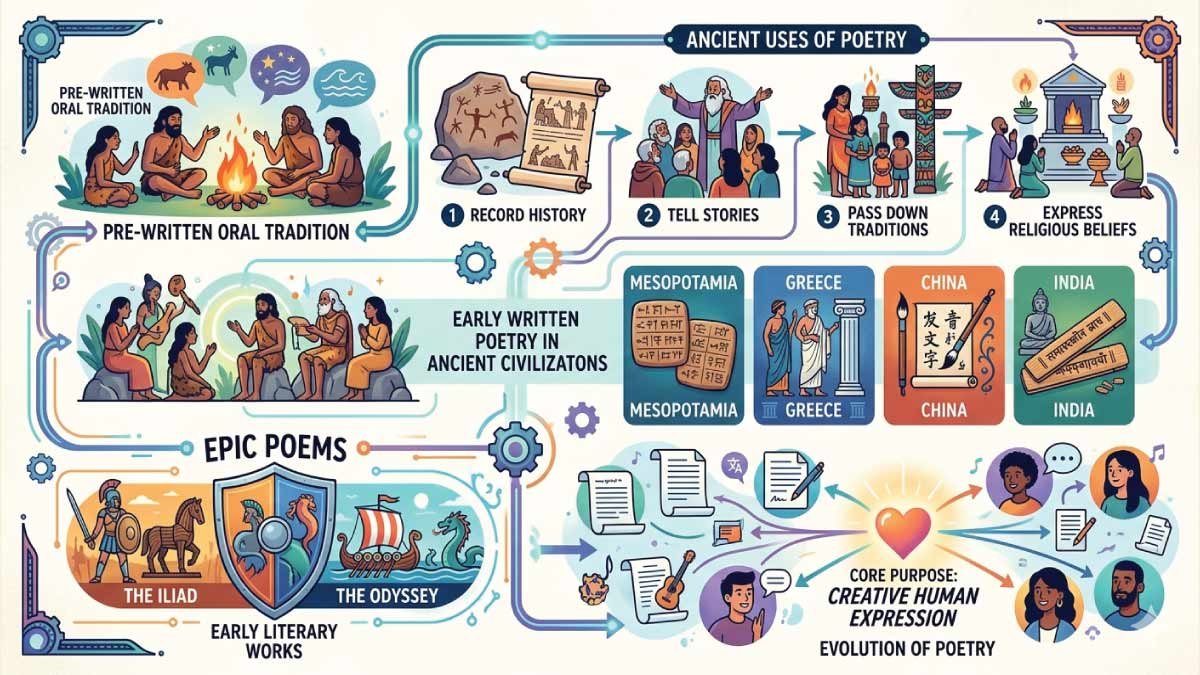
Poetry is one of the oldest forms of human expression, beginning long before written language existed. It started as oral storytelling used by early humans to share experiences, emotions, and knowledge. Over time, it became structured and preserved in written form across different cultures and civilizations.
Poetry was used as an oral tradition. Ancient civilizations used poems to:
- Record history
- Tell stories
- Pass down traditions
- Express religious beliefs
Some of the earliest known poetry comes from ancient civilizations like Mesopotamia, Greece, China, and India. Epic poems such as The Iliad and The Odyssey are examples of early literary poetry.
Over time, poetry evolved into many forms, styles, and languages, but its core purpose remained the same—expressing human emotions creatively.
Key Features of Poetry
Poetry has several unique features that make it different from other forms of writing. These features give poetry its emotional depth, artistic beauty, and expressive power. Through structure, language, and creativity, poetry delivers meaning in a compact yet impactful way that connects deeply with readers.
1. Emotional Expression
Poetry is strongly connected with human emotions. It expresses feelings like love, sadness, joy, anger, fear, and hope in a powerful way. Poets use words to reflect inner experiences and emotional states. This emotional expression allows readers to feel connected, understood, and emotionally engaged with the poem.
2. Rhythm and Sound
Rhythm and sound are important elements of poetry. Poems often include rhyme, repetition, and structured beats that create a musical flow. This musical quality makes poetry enjoyable to read aloud and listen to. The rhythm adds harmony and enhances the emotional impact of words and ideas.
3. Imagery
Imagery in poetry means using descriptive language to create mental pictures. Poets carefully choose words that appeal to the senses like sight, sound, smell, taste, and touch. This helps readers visualize scenes and emotions clearly, making the poem more vivid, meaningful, and emotionally engaging.
4. Figurative Language
Poetry frequently uses figurative language such as metaphors, similes, symbolism, and personification. These techniques allow poets to express deeper meanings beyond literal interpretation. Figurative language adds creativity, richness, and layers of meaning, helping readers interpret emotions and ideas in a more imaginative way.
5. Concise Language
Poetry is known for its short and powerful use of language. Unlike long prose, poetry communicates big ideas in fewer words. Every word is carefully selected for meaning and impact. This conciseness makes poetry more intense, meaningful, and emotionally effective for readers.
Structure of Poetry
Poetry has a unique structure that is different from prose writing. Instead of paragraphs, it is arranged in lines and stanzas. This structure helps create rhythm, meaning, and visual appeal. Elements like rhyme scheme, meter, and line arrangement work together to shape the flow and impact of a poem.
1. Lines
Lines are the basic building blocks of poetry. Each line may express a complete idea or a part of a thought. Poets use line breaks carefully to control rhythm, emphasis, and meaning. A single line can create strong emotional or visual impact in a poem.
2. Stanzas
A stanza is a group of lines in a poem, similar to a paragraph in prose. It organizes ideas into sections, making the poem easier to read and understand. Each stanza may present a new idea, emotion, or image, helping structure the poem clearly and effectively.
3. Rhyme Scheme
Rhyme scheme refers to the pattern of rhyming words at the end of lines in a poem. It is usually represented by letters such as AABB or ABAB. Rhyme scheme adds musical quality, rhythm, and flow, making the poem more engaging and enjoyable for readers.
4. Meter
Meter is the rhythmic structure of a poem based on stressed and unstressed syllables. It creates a beat or flow in the reading of poetry. Traditional poems often follow strict meter patterns, while modern poetry may use flexible or irregular rhythms to express ideas more freely.
Modern poetry does not always follow strict structural rules. Free verse poetry is a common example where rhyme and meter are not required. This allows poets more creative freedom to express thoughts naturally and experiment with language, style, and emotional depth without limitations.
Types of Poetry in Literature
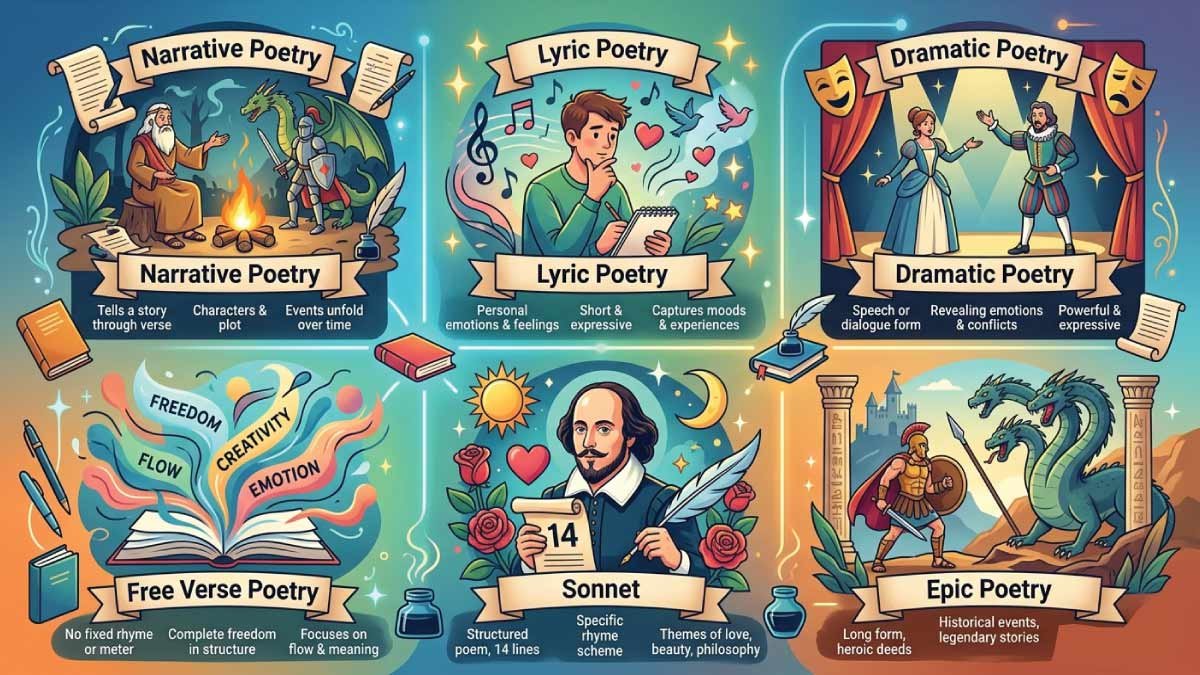
Poetry exists in many forms, each with its own structure, purpose, and style. Different types of poetry allow poets to express stories, emotions, and ideas in unique ways. From storytelling to emotional expression, each form plays an important role in the world of literature.
1. Narrative Poetry
Narrative poetry tells a story through verse. It includes characters, a plot, and events that unfold over time. This type of poetry is similar to short stories but written in a poetic form. It often focuses on adventure, history, or moral lessons presented in a creative way.
2. Lyric Poetry
Lyric poetry focuses on personal emotions and feelings. It is usually short and expressive, reflecting the inner thoughts of the poet. This type of poetry does not tell a story but instead captures moods, emotions, and personal experiences in a musical and heartfelt style.
3. Dramatic Poetry
Dramatic poetry is written in the form of a speech or dialogue. It often features a speaker addressing an audience or another character. This form of poetry is highly expressive and is used to reveal emotions, conflicts, or dramatic situations in a powerful way.
4. Free Verse Poetry
Free verse poetry does not follow any fixed rhyme scheme or meter. It gives poets complete freedom in structure and expression. This modern form of poetry focuses more on natural flow, emotion, and meaning rather than strict rules, making it flexible and creative.
5. Epic Poetry
Epic poetry is a long form of poetry that describes heroic deeds, historical events, or legendary stories. It often includes gods, warriors, and grand adventures. Epics are known for their scale, depth, and importance in preserving cultural and historical traditions.
6. Sonnet
A sonnet is a structured poem consisting of 14 lines with a specific rhyme scheme. It often explores themes like love, beauty, or philosophy. Sonnets are known for their strict form and emotional intensity, making them one of the most famous classical poetry styles.
Each type of poetry serves a different purpose, but all share a common goal—creative expression of thoughts, emotions, and human experience in a meaningful and artistic way.
Also Read:
Importance of Poetry in Literature
Poetry holds a very powerful place in both literature and human life. It is not just artistic writing but also a medium that expresses emotions, culture, ideas, and healing. Through simple yet meaningful language, poetry connects people with thoughts and feelings that are often difficult to express in daily communication.
1. Emotional Expression
Poetry allows people to express deep emotions that are hard to explain in ordinary language. Feelings like love, pain, sadness, joy, and hope become more powerful when written in poetic form. It gives voice to inner thoughts and helps individuals release emotional burden in a meaningful way.
2. Cultural Reflection
Poetry reflects the culture, traditions, and values of a society. It captures historical experiences, social beliefs, and community life. Through poetry, readers can understand how people lived, thought, and felt in different eras. It becomes a cultural mirror that preserves identity and heritage.
3. Artistic Beauty
One of the greatest strengths of poetry is its artistic beauty. Through rhythm, rhyme, and creative word choice, poetry transforms language into art. Even simple ideas become beautiful and meaningful. This aesthetic quality makes poetry enjoyable, memorable, and emotionally powerful for readers.
4. Communication of Ideas
Poetry is an effective way to communicate deep philosophical, moral, and social ideas. Complex thoughts can be expressed in simple and symbolic language. Poets often use metaphors and imagery to explain life, society, and human nature in a way that is both impactful and easy to understand.
5. Healing and Therapy
Many people use poetry as a form of emotional healing and therapy. Writing or reading poetry helps in dealing with stress, sadness, and personal struggles. It provides comfort, self-expression, and mental relief. Poetry becomes a safe space where emotions can be understood and released.
Literary Devices Used in Poetry
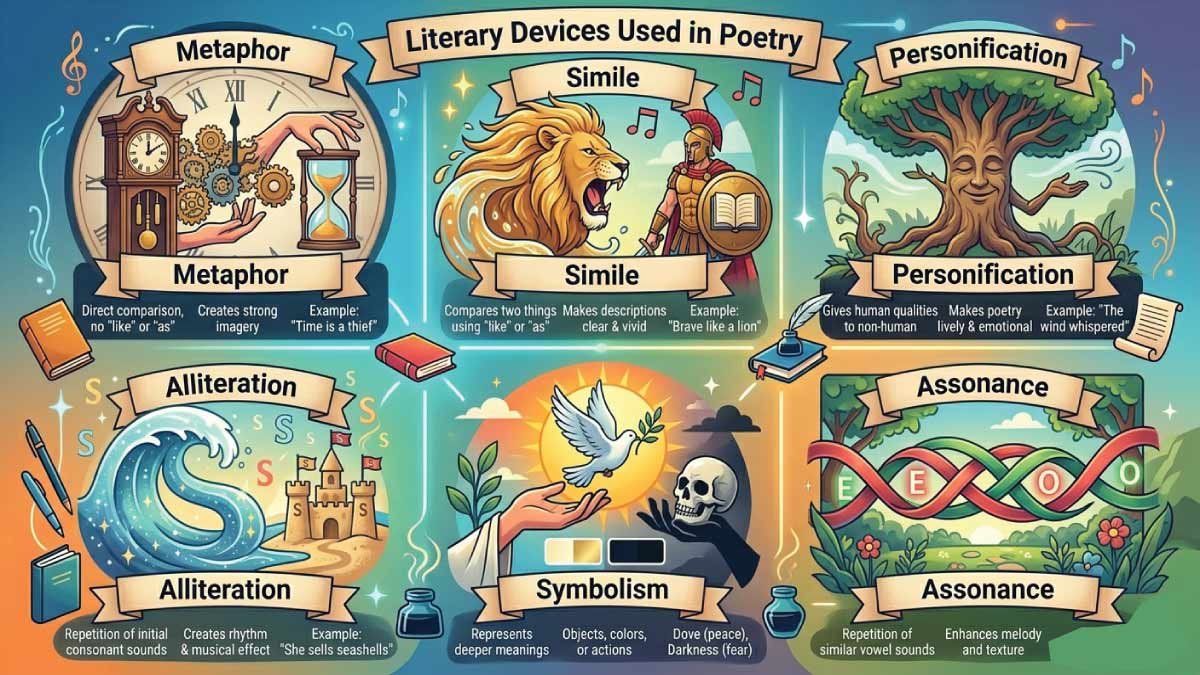
Poets use various literary devices to make their writing more expressive, meaningful, and creative. These techniques add depth, beauty, and emotional impact to poetry. They help readers connect with hidden meanings and enjoy language in a more imaginative way.
1. Metaphor
A metaphor is a direct comparison between two different things without using “like” or “as.” It helps create strong imagery and deeper meaning. For example, saying “time is a thief” suggests that time takes things away, even though it is not literally a thief.
2. Simile
A simile compares two things using words like “like” or “as.” It makes descriptions clearer and more vivid. For example, “brave like a lion” helps readers easily understand courage by comparing it with a lion’s strength and fearlessness.
3. Personification
Personification gives human qualities to non-human objects or ideas. It makes poetry more lively and emotional. For example, saying “the wind whispered” creates imagination by giving the wind the ability to act like a human being.
4. Alliteration
Alliteration is the repetition of the same consonant sound at the beginning of nearby words. It creates rhythm and musical effect in poetry. This technique makes lines more memorable and pleasing to read or hear, enhancing the overall flow of the poem.
5. Symbolism
Symbolism uses objects, colors, or actions to represent deeper meanings beyond their literal sense. It allows poets to express complex ideas in a simple form. For example, a “dove” often symbolizes peace, while “darkness” may represent fear or sadness.
These literary devices make poetry more expressive, imaginative, and meaningful. They transform simple language into powerful artistic expression, allowing readers to feel and interpret poetry on multiple levels.
Also Read:
Difference Between Poetry and Prose
Understanding the difference between poetry and prose helps clarify poetry’s role in literature.
| Poetry | Prose |
|---|---|
| Written in lines and stanzas | Written in paragraphs |
| Focuses on emotions and rhythm | Focuses on information and storytelling |
| Uses figurative language | Uses straightforward language |
| Short and expressive | Longer and descriptive |
Poetry is more artistic, while prose is more direct and explanatory.
Role of Poetry in Modern Literature
In modern literature, poetry continues to hold a strong and meaningful place. It has adapted to contemporary life, using simpler language, diverse structures, and new creative styles. Modern poets focus on real-life experiences and emotional depth, making poetry more relatable and accessible to today’s readers.
Modern poets often write about:
- Social issues
- Mental health
- Love and relationships
- Identity and culture
- Personal struggles
Social media has also made poetry more popular, especially short and expressive forms like micro-poetry and Instagram poetry.
Why People Read Poetry
People read poetry for many emotional, intellectual, and personal reasons. It helps readers connect with deeper feelings that are often hard to express in everyday language. Poetry also offers comfort, inspiration, and a sense of understanding in different life situations.
People read poetry for different reasons:
- To feel emotions deeply
- To find inspiration
- To enjoy artistic language
- To understand human experiences
- To connect with personal feelings
Poetry creates a strong emotional connection between the writer and the reader.
How Poetry Impacts Human Life
Poetry has a deep and powerful influence on human thoughts, emotions, and overall perspective on life. It allows individuals to explore their inner world and understand emotions that are often difficult to express in normal conversation. Through poetic language, people connect more deeply with themselves and others.
Poetry helps people:
- Understand themselves better
- Express hidden feelings
- Build empathy for others
- Find comfort during difficult times
- Appreciate beauty in language
Poetry is not just literature, it is a reflection of life itself.
Conclusion
Poetry in literature is a powerful and artistic form of writing that expresses emotions, ideas, and experiences in a creative way. It uses rhythm, imagery, and figurative language to create deep meaning in a few words.
From ancient times to modern literature, poetry has remained a vital part of human expression. It connects people emotionally, culturally, and intellectually. Whether it is a simple short poem or a long epic, poetry continues to inspire and move readers around the world.
In short, poetry is not just writing, it is the voice of the heart expressed through words.
Also Read:
FAQs:
What is poetry in literature?
Poetry in literature is a creative form of writing that uses rhythm, imagery, and expressive language to convey emotions and ideas. It is usually written in lines and stanzas instead of paragraphs. Poetry focuses on beauty, sound, and meaning, allowing writers to communicate deep feelings in a powerful and artistic way.
What are the main features of poetry?
The main features of poetry include emotional expression, rhythm, imagery, figurative language, and concise wording. Poetry often uses rhyme and sound patterns to create musical effects. It also relies on creative techniques like metaphors and symbolism to add depth, making the writing more meaningful and engaging for readers.
What are the different types of poetry?
There are many types of poetry, including narrative, lyric, dramatic, epic, sonnet, and free verse. Each type has its own style and purpose. Some poems tell stories, while others express emotions or ideas. These different forms allow poets to explore creativity and present their thoughts in unique ways.
Why is poetry important in literature?
Poetry is important in literature because it expresses emotions, reflects culture, and communicates deep ideas in a creative way. It adds beauty to language and helps readers connect with human experiences. Poetry also preserves traditions and offers insight into different societies, making it valuable across generations and cultures.
How is poetry different from prose?
Poetry differs from prose in structure and style. It is written in lines and stanzas, while prose uses paragraphs. Poetry focuses on rhythm, sound, and emotion, often using figurative language. Prose is more direct and explanatory. Poetry aims to evoke feelings, while prose mainly conveys information and stories.
How can beginners understand poetry easily?
Beginners can understand poetry by reading slowly and more than once. Focusing on emotions, imagery, and key words helps reveal meaning. It is also useful to identify literary devices and themes. With regular practice and patience, understanding poetry becomes easier and more enjoyable over time for new readers.