
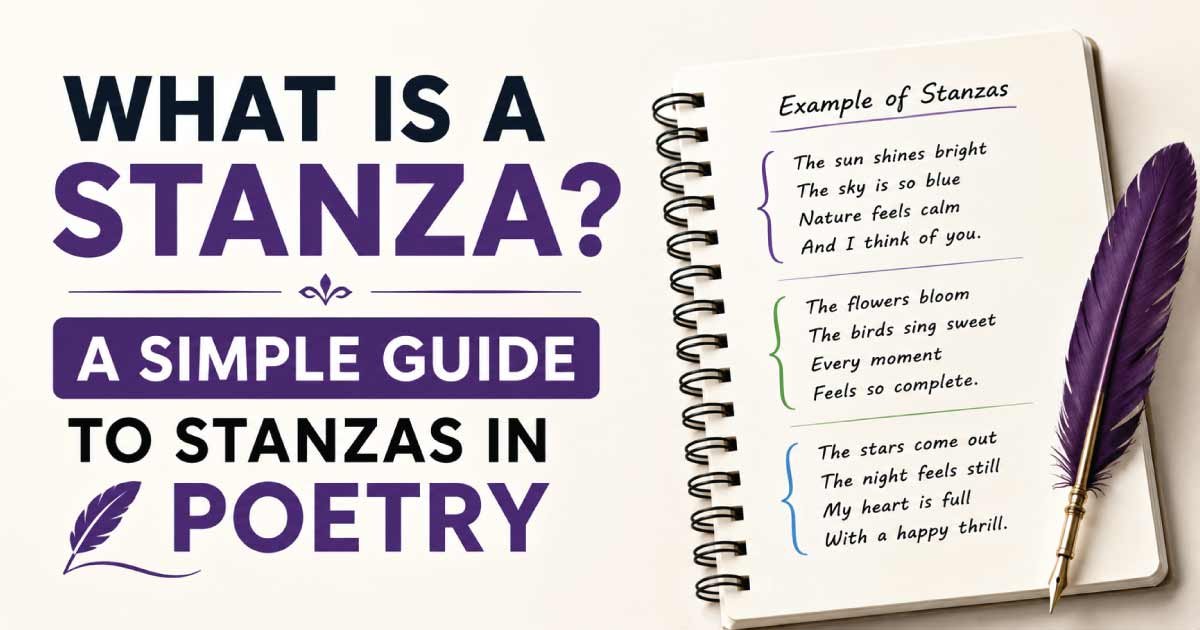
A stanza is a group of lines in a poem that are arranged together as a separate section. It is similar to a paragraph in prose because it helps organize a poem’s ideas, images, emotions, or story.
Stanzas can contain different numbers of lines, and poets use them in many ways. A poem may have two-line stanzas, four-line stanzas, six-line stanzas, or irregular groups of lines. Some poems use the same stanza pattern throughout, while others deliberately change the number of lines from one section to another.
Understanding what a stanza is makes poetry easier to read, analyze, and write. Stanzas can create pauses, separate ideas, establish rhythm, emphasize important moments, and guide readers through a poem.
What Is a Stanza in Poetry?
A stanza is a group of two or more lines in a poem that are visually and structurally connected. Stanzas are usually separated from one another by a blank space.
For example:
The morning sun begins to rise,
And golden light fills up the skies.The birds begin their morning song,
As gentle winds move leaves along.
This short poem contains two stanzas, with each stanza containing two lines.
The first stanza introduces the sunrise, while the second develops the scene by describing birds and wind.
Simple Definition of a Stanza
In simple words:
A stanza is a group of lines in a poem that forms a separate section, much like a paragraph in an essay or story.
The word “stanza” comes from Italian and means “room” or “station.” The idea fits poetry because each stanza can function like a separate space within a poem.
Why Are Stanzas Important in Poetry?
Stanzas help poets organize their writing. Without stanza breaks, a long poem could become visually difficult to read and harder to follow.
A stanza can represent a new:
- Idea
- Emotion
- Scene
- Character
- Moment
- Description
- Stage of a story
- Point in an argument
For example, a poem about childhood might use one stanza to describe a childhood home, another to describe family memories, and a final stanza to reflect on growing older.
Stanzas Create Structure
A stanza gives a poem a sense of organization.
Just as paragraphs divide an article into manageable sections, stanzas divide poetry into meaningful groups of lines.
However, stanzas can do more than simply organize text. A poet can deliberately use stanza breaks to create suspense, silence, contrast, or emphasis.
How Many Lines Are in a Stanza?
There is no single required number of lines in every stanza.
Different types of stanzas have traditional names based on the number of lines they contain.
| Stanza Name | Number of Lines |
|---|---|
| Couplet | 2 |
| Tercet | 3 |
| Quatrain | 4 |
| Quintain | 5 |
| Sestet | 6 |
| Septet | 7 |
| Octave | 8 |
| Nine-line stanza | 9 |
| Ten-line stanza | 10 |
These traditional names are useful when discussing formal poetry, but modern poets may create stanzas of any length.
What Is a Couplet?
A couplet is a stanza consisting of two lines.
Couplets are among the simplest stanza forms. They often rhyme, although they do not have to.
For example:
The stars appear above the sea,
And night brings quiet peacefully.
The two lines form a couplet.
How Couplet Stanzas Are Used
Couplets can:
- Express a complete thought
- Create a memorable ending
- Establish a rhyme
- Summarize an idea
- Add rhythm to a poem
Because they are short, couplets are common in children’s poetry, songs, traditional poetry, and poetic quotations.
What Is a Tercet?
A tercet is a three-line stanza.
Tercets can follow different rhyme patterns depending on the poem.
For example:
The morning opens soft and bright,
The clouds drift slowly out of sight,
And birds awaken with the light.
The three lines form one tercet.
Tercets can also be combined to create larger poetic forms. Some traditional poems use repeated groups of three lines throughout the entire work.
What Is a Quatrain?
A quatrain is a four-line stanza and is one of the most common stanza forms in English poetry.
For example:
The river moves beneath the sky,
While clouds go drifting slowly by.
The trees stand tall beside the stream,
And sunlight makes the water gleam.
These four lines form a quatrain.
Why Are Quatrains So Common?
Quatrains provide enough space to develop an idea while remaining short and organized.
They can be used for:
- Storytelling
- Description
- Love poetry
- Nature poetry
- Songs
- Children’s poems
- Traditional forms
Quatrains can also use many different rhyme schemes, such as ABAB, AABB, ABBA, or no rhyme at all.
What Is a Quintain?
A quintain is a stanza containing five lines.
Five-line stanzas are less common than couplets and quatrains, but they appear in several traditional poetic forms.
A quintain may have a specific rhyme pattern, depending on the form in which it appears.
The extra line can allow a poet to expand an idea, add an image, or create a stronger conclusion.
What Is a Sestet?
A sestet is a six-line stanza.
The word is particularly important when discussing the Petrarchan sonnet, where the final six lines traditionally form the sestet after an opening eight-line octave.
A sestet can provide:
- A conclusion
- A change in perspective
- A response to an earlier idea
- A solution to a problem
- A final emotional development
What Is an Octave?
An octave is an eight-line stanza.
The term is especially associated with traditional sonnet structure. In a Petrarchan sonnet, the first eight lines form the octave and are followed by a six-line sestet.
The octave often introduces a situation, question, problem, or central idea, while the sestet develops or responds to it.
Do All Poems Have Stanzas?
No. Not every poem uses traditional stanzas.
Some poems are written as a continuous block of lines. Others may use unusual spacing or deliberately irregular sections.
Modern and experimental poets sometimes avoid traditional stanza structures because the visual arrangement itself can contribute to the poem’s meaning.
Why Might a Poet Avoid Stanzas?
A poet may choose not to use stanza breaks to:
- Create a continuous flow
- Represent uninterrupted thought
- Increase tension
- Make the poem feel conversational
- Experiment with visual form
- Reflect confusion or disorder
The absence of stanza breaks can therefore be an intentional artistic choice.
What Is the Difference Between a Stanza and a Paragraph?
A stanza and a paragraph are similar because both divide writing into sections, but they belong to different forms of writing.
| Stanza | Paragraph |
|---|---|
| Used mainly in poetry | Used mainly in prose |
| Contains poetic lines | Contains sentences |
| May use rhyme and rhythm | Usually follows prose structure |
| Line breaks are important | Sentences normally run continuously |
| Can organize images and emotions | Usually develops an idea or argument |
| May follow a formal pattern | Usually follows paragraph conventions |
A stanza is sometimes described as the poetry equivalent of a paragraph, but the two are not exactly the same.
How Do Stanza Breaks Affect a Poem?
A stanza break is not merely an empty space. It can influence how a reader experiences the poem.
Creating a Pause
A blank space between stanzas naturally gives readers a moment to pause.
This can slow the poem down and allow an important thought to sink in.
Separating Ideas
A poet can use different stanzas for different ideas.
For example:
- Stanza 1: Introduces a problem
- Stanza 2: Describes its effect
- Stanza 3: Offers hope
- Stanza 4: Provides a conclusion
Changing the Mood
A new stanza can signal an emotional shift.
A poem may begin with sadness and gradually move toward hope. A stanza break can help emphasize that transition.
Creating Emphasis
A short final stanza can make the ending particularly powerful.
For example, after several long stanzas, a poet might finish with only two lines. The sudden change in structure can draw attention to those final words.
Discover More:
What Is a Stanza Break?
A stanza break is the space separating one stanza from another.
Consider this example:
I walked beside the quiet shore,
And watched the waves return once more.The evening slowly turned to gray,
And carried all the light away.
The blank space between “more” and “The” is the stanza break.
Why Do Poets Use Stanza Breaks?
Stanza breaks can indicate:
- A change in subject
- A change in time
- A change in location
- A change in speaker
- A new emotion
- A transition in a story
- A pause for reflection
When reading a poem, it is useful to notice where the poet chooses to create these spaces.
Can Stanzas Rhyme?
Yes. Stanzas can contain rhyming lines, but rhyme is not required.
A poet may create a consistent rhyme scheme throughout a poem or change the rhyme pattern between stanzas.
For example, a four-line stanza might use an ABAB pattern:
The moon is shining on the sea (A)
The stars are scattered in the night (B)
A gentle breeze moves quietly free (A)
While silver clouds reflect the light (B)
The first and third lines rhyme, while the second and fourth lines rhyme.
Do Free Verse Stanzas Rhyme?
Usually, free verse does not follow a fixed rhyme scheme, although individual rhymes can still appear naturally.
Free verse poets may focus more on:
- Natural speech
- Imagery
- Rhythm
- Line breaks
- Repetition
- Meaning
Discover More:
How to Identify a Stanza in a Poem
Identifying a stanza is usually simple.
Look for groups of lines that are separated by blank spaces.
For example:
The garden wakes beneath the sun,
A new and peaceful day begun.The flowers open one by one,
Their colors shining in the sun.
There are two stanzas because the poem is divided into two groups of lines.
Count the Lines
Once you identify a stanza, count its lines.
If it contains:
- 2 lines → couplet
- 3 lines → tercet
- 4 lines → quatrain
- 5 lines → quintain
- 6 lines → sestet
- 8 lines → octave
This makes it easier to describe the poem’s structure.
Discover More:
How to Use Stanzas When Writing Poetry
If you are writing your own poem, stanza structure can help you organize your thoughts.
Give Each Stanza a Purpose
One useful approach is to give every stanza a particular role.
For example, in a poem about overcoming a difficult experience:
Stanza 1: Describe the difficult moment.
Stanza 2: Explain the emotional struggle.
Stanza 3: Introduce a reason for hope.
Stanza 4: End with a positive reflection.
This structure gives the poem a natural progression.
Experiment With Stanza Length
You do not have to make every stanza the same length.
For example, you might use:
- Four lines to introduce an idea
- Six lines to develop it
- Two lines to conclude
Different stanza lengths can create contrast and emphasis.
Use Blank Space Intentionally
Do not add stanza breaks randomly. Think about what you want the reader to feel when reaching the empty space.
A break can create a moment of silence before an important statement.
Stanzas in Different Types of Poetry
Different poetic forms use stanzas in different ways.
| Poetry Form | Common Stanza Structure |
|---|---|
| Sonnet | Often divided into sections such as octave and sestet or quatrains and a couplet |
| Ballad | Often uses quatrains |
| Haiku | Traditionally three lines, though its structure is more nuanced than simply treating it as a stanza |
| Limerick | Five lines |
| Free Verse | Flexible and often irregular |
| Villanelle | Repeated tercets followed by a quatrain |
| Rondeau | Uses repeated refrains and specific stanza patterns |
These are traditional or common patterns rather than rules that apply to every modern example.
Why Should Students Learn About Stanzas?
Learning about stanzas helps students understand how poems are constructed.
When analyzing poetry, students can examine:
- How many stanzas a poem contains
- How many lines each stanza has
- Whether the stanzas follow a pattern
- Whether rhyme changes between stanzas
- Whether the subject changes
- Whether the mood changes
- How the final stanza contributes to the poem
Understanding structure can reveal meaning that may not be obvious from the words alone.
Frequently Asked Questions About Stanzas
What is a stanza in simple words?
A stanza is a group of lines in a poem that are arranged together as a separate section. It is similar to a paragraph in prose.
How many lines are in a stanza?
A stanza can have different numbers of lines. Common forms include couplets with two lines, tercets with three, quatrains with four, and sestets with six.
Is a stanza the same as a paragraph?
Not exactly. A stanza is used in poetry, while a paragraph is primarily used in prose. They both organize writing into sections, however.
Does every poem have stanzas?
No. Some poems use no stanza breaks, while others use regular or irregular stanza patterns.
What is a four-line stanza called?
A four-line stanza is called a quatrain.
What is a two-line stanza called?
A two-line stanza is called a couplet.
What is a three-line stanza called?
A three-line stanza is called a tercet.
Can a stanza have one line?
Traditional definitions generally describe a stanza as a group of lines, but modern poetry can use unusual structures, including isolated lines separated visually from other sections.
Why do poets use stanzas?
Poets use stanzas to organize ideas, create pauses, separate scenes or emotions, establish patterns, and control the visual and rhythmic flow of a poem.
Conclusion: Understanding What a Stanza Is
A stanza is a group of lines in a poem that forms a separate section, much like a paragraph in prose. Stanzas help poets organize ideas, emotions, descriptions, stories, and changes in mood.
Stanzas can contain different numbers of lines. A two-line stanza is a couplet, a three-line stanza is a tercet, a four-line stanza is a quatrain, and a six-line stanza is a sestet.
However, modern poetry is flexible. A poet does not always need to follow traditional stanza patterns. Free verse and experimental poetry may use irregular structures or no stanza breaks at all.
When reading poetry, pay attention not only to the words but also to the spaces between groups of lines. A stanza break can create a pause, separate an idea, change the mood, or make the next words more powerful.
Once you understand what a stanza is, you have one more useful tool for reading, analyzing, and writing poetry with greater confidence.